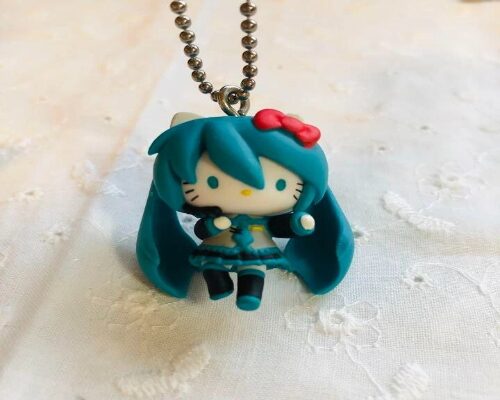
When two globally popular characters seriously “merge,” this is what happens──.
The Hatsune Miku × Hello Kitty Ball-Chain Mascot compresses Miku’s twin-tails and costume into Hello Kitty’s simple face, a palm-sized special collaboration item.
Originally a quietly released capsule-gacha mini-figure, it has since gone out of production and become a rare collectible sought by fans both inside and outside Japan.
“Love both Miku and Kitty” or “want to subtly make my desk or bag otaku-style” — this mascot reliably hits those buttons.
- Product details
- Other series in this product line (“friends” lineup)
- What is Hatsune Miku?
- Why Hatsune Miku is loved around the world
- Hatsune Miku–related products
- High-profile Hatsune Miku collaboration projects
- 1. Good Smile Racing × Hatsune Miku “Racing Miku”
- 2. Toyota × Hatsune Miku (TOYOTA USA “COROLLA × Miku” campaign)
- 3. FamilyMart × Hatsune Miku (“Miku-man” & fair)
- 4. Lawson × Hatsune Miku collaboration campaigns
- 5. Sapporo Snow Festival × Snow Miku (SNOW MIKU)
- 6. Sanrio × Hatsune Miku (Hello Kitty collaboration)
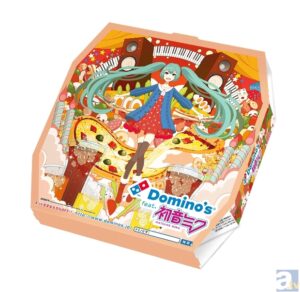
- 7. Domino’s Pizza Japan × Hatsune Miku (Domino’s app collaboration)
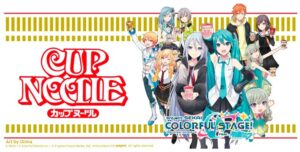
- 9. Nissin Cup Noodles × Hatsune Miku / Project SEKAI
- About Sanrio
- Sanrio Puroland (Tama, Tokyo)
- Top 5 Sanrio characters popular overseas
- Summary
Product details
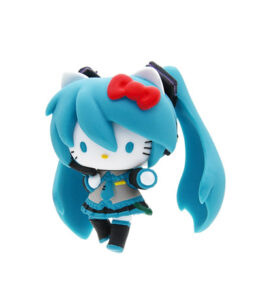
Source:Kitan Club
Product name
Hatsune Miku × Hello Kitty Ball-Chain Mascot
Manufacturer / brand
Capsule toy maker Kitan Club
Officially licensed Sanrio product
Triple collaboration with Hatsune Miku (Crypton Future Media)
Release timing & sales format
Release period: around September 2012
Sales format: Gachapon (capsule toy)
Distributed via capsule machines placed in toy stores, anime shops, and big-box retailers nationwide
Specifications & size
Material: PVC soft vinyl + metal ball chain
Size: roughly 4 cm — mini-figure size
Easy-to-use size for keychains or bag charms
Lineup (6 total types)
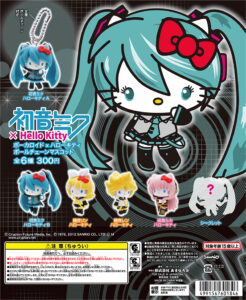
Source:Kitan Club
Hatsune Miku × Hello Kitty (two pose variants)
Kagamine Rin × Hello Kitty
Kagamine Len × Hello Kitty
Megurine Luka × Hello Kitty
Secret (surprise)
※ All feature a “Hello Kitty face × Vocaloid outfit” mixed design
Design characteristics
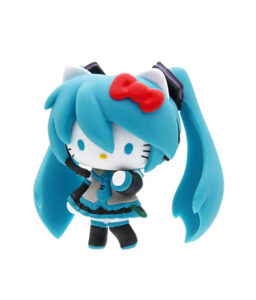
The face is purely Hello Kitty; hair style, costume, and color scheme are taken from Hatsune Miku (or other Vocaloids) — a “hybrid” sculpt.
The Miku variant features her signature twin-tails and cyber-ish outfit, with Hello Kitty’s red ribbon perched on Miku’s hair as a cute point.
Cute and gag-like elements coexist; it’s a distinctly gacha-style, playful design.
Current availability difficulty
Production has ended; no reprints.
Now obtainable mainly from the secondhand market (flea market apps, auctions, collector shops).
Items in excellent condition, with tags, or full sets are especially popular among collectors.
Other series in this product line (“friends” lineup)
The Hatsune Miku × Hello Kitty Ball-Chain Mascot is not just a one-off Miku item — it appeared as part of a broader Vocaloid × Sanrio collaboration series.
Examples of characters in the same series include:
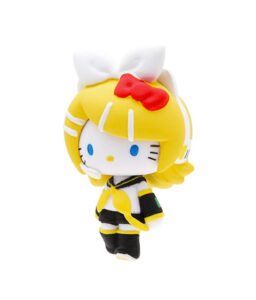
Kagamine Rin × Hello Kitty
Source:Kitan Club
Hello Kitty’s silhouette combined with short yellow hair and a large ribbon, plus a sailor-style outfit. Rin’s energetic, bright image is expressed in a small, seated, deformed figure.
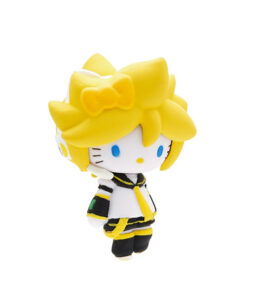
Kagamine Len × Hello Kitty
Source:Kitan Club
A mischievous boy Len reinterpreted with a Hello Kitty face. The sculpt includes headset-like details and short pants, reproducing Len’s traits in miniature.
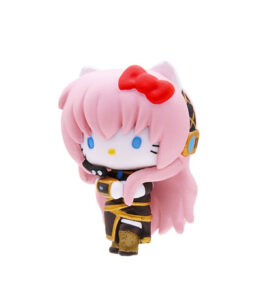
Megurine Luka × Hello Kitty
Source:Kitan Club
Long pink hair paired with black-and-gold clothing creates an “older-sister Kitty.” The contrast between Luka’s cool, mature vibe and Kitty’s round form feels fresh.
Source:Kitan Club
Even within Miku, there were pose- and expression-variant releases:
Energetic pose with both hands raised
Sitting pose
Such subtle differences increase collectibility; many collectors aim to “complete only the Miku set.”
Additionally, the lineup included one secret slot — color variants, special poses, or rare characters — the “spin-the-gacha and find out” thrill that defines this series.
What is Hatsune Miku?
Source:piapro
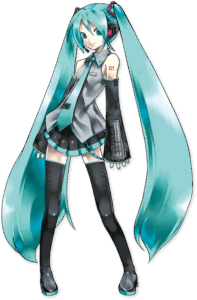
Hatsune Miku is a character for the voice-synthesis software VOCALOID, developed by Crypton Future Media.
Originally software for making songs sing, she has now become established worldwide as a “virtual singer” and “digital idol.”
Birth and origin
Product name: “Character Vocal Series 01: Hatsune Miku”
Release date (official birthday): August 31, 2007
The name “Hatsune Miku” carries the image of “the first sound (hatsune) heard from the future.” Every year on August 31, commemorative events and concerts are held in Sapporo, Tokyo, and overseas — the birthday culture is well established.
Character design and “the person inside”
Source:Hatsune Miku official blog
Initial development and planning: Crypton Future Media (a Sapporo-based music software company)
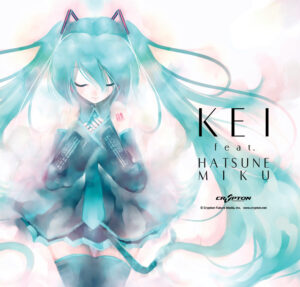
Character design: illustrator KEI
Voice base: voice actress Saki Fujita’s voice was recorded and used to create the singing voice library
Visual features:
Long emerald-green twin-tails
Sleeveless uniform-like outfit with a tie
Headset and arm covers — design elements that emphasize “a character who sings”
Hatsune Miku was crafted to land on that near-borderline of being software while giving a human-like presence.
Why Hatsune Miku is loved around the world
It’s not just because she’s a cute character. Miku has clear strengths that sustain her long-term popularity.
1. Fans can become “producers”
Hatsune Miku’s core concept allows fans to create songs, make her sing them, and publish them to the world.
Composers make original songs and upload them to platforms like Niconico and YouTube.
Those uploads spawn a chain of secondary creations: videos, illustrations, novels, 3D models, cosplay.
Rather than the official side producing everything, a culture of “everyone raising Miku’s world together” emerged. This fan-driven ecosystem is Miku’s defining feature.
2. Instantly recognizable iconic design
Source:Hatsune Miku official blog
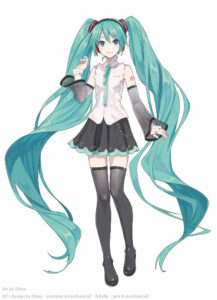
Aqua twin-tails
Black × cyan outfit
Digital-style accessories
This visual language has become a symbol that transcends countries and languages. For overseas fans, it reaches the level of “you may not know her name, but you’ve seen the twin-tailed girl,” functioning like Hello Kitty or Pikachu as an iconic character.
3. Strength of multimedia expansion
Source:Famitsu
Hatsune Miku has expanded beyond mere software:
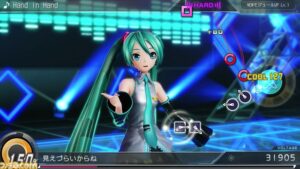
Music games: the “Hatsune Miku -Project DIVA-” series, etc.
3D hologram concerts held in Japan, North America, Europe, and Asia
Figures, prize goods, plushes, stationery, apparel — a broad goods ecosystem
The flow “song → game → live → merchandise” is solidified, offering many ways to be a fan and contributing to sustained support.
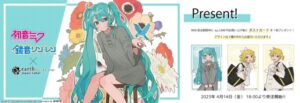
4. Breadth of collaborations
Source:Hatsune Miku official blog
Hatsune Miku is unmatched in collaboration variety:
Fashion brands (e.g., earth music & ecology)
Beverages and food (bottled drinks, cup noodle tie-ins)
Local governments (tourism PR, transportation collaborations)
Corporate, gaming, and other character tie-ups
Among these, the “Hello Kitty × Hatsune Miku” collab stands out as a high-impact project — a “global character × virtual singer” pairing that resonated both in Japan and overseas. The Hatsune Miku × Hello Kitty Ball-Chain Mascot sits on that collaboration continuum: one tiny three-dimensional item that embodies “two global icons inhabiting a single figure,” a collector-pleasing piece of fan psychology.
Hatsune Miku–related products
1. Hatsune Miku -Project DIVA- Mega39’s (Nintendo Switch)
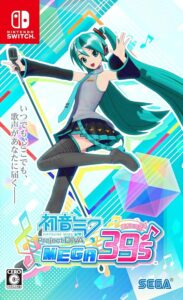
Source:Amazon
Genre: Rhythm game
Platform: Nintendo Switch
Content: Rhythm game featuring over 100 classic Vocaloid songs.
Features:
Motion-sensor “feel” mode using Joy-Con as well as traditional button play
Switchable rendering between anime-style toon shading and a more realistic model
Rich costume (module) and customization features to style your “favorite Miku”
Recommended points:
Easy for overseas players to enjoy on Switch — great Miku introduction
Playable in TV or handheld mode, offering a home-concert feel
2. Hatsune Miku -Project DIVA- Future Tone DX
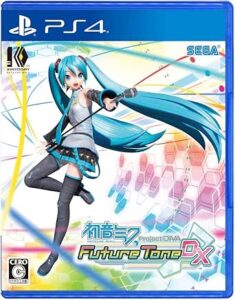
Source:Amazon
Genre: Rhythm game
Platform: PlayStation 4
Content: Based on the arcade “Project DIVA,” a massive, almost-complete collection music game.
Features:
Over 200 songs + many additional modules (costumes)
High-quality arcade-level visuals and extensive PV (music video) viewing modes
Wide difficulty range for beginners to expert rhythm gamers
Recommended points:
Popular with overseas fans who want to revisit Miku’s signature songs
Even non-players enjoy it as an MV compilation
3. Nendoroid Hatsune Miku (GOOD SMILE COMPANY)
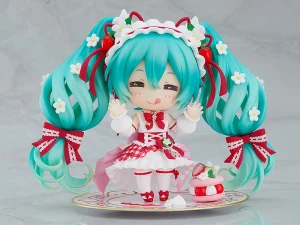
Source:Good Smile Company
Genre: Chibi-style figure (~10 cm)
Content: The Nendoroid line’s Hatsune Miku has numerous variants from the original release (Series No.33) to Snow Miku, Sakura Miku, Racing Miku, etc. Variety is enormous.
Features:
Cute, squishy chibi styling and large eyes
Interchangeable faceplates, arms, legs, and accessories for posing play
Many limited and event editions — high collectibility
Recommended points:
A staple Miku collectible internationally
Attractive packaging makes both unopened display and open-play collectors happy
4. 1/7 & 1/8 scale Hatsune Miku figures (various manufacturers)
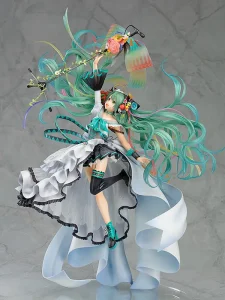
Source:Tsurumai Hobby
Genre: Scale figure (~20 cm)
Content: Numerous large-scale figures from Good Smile Company and other makers — detailed, larger statues.
Representative lineups:
Standard Hatsune Miku (various versions)
Racing Miku series (annual design changes)
Illustrator-collaboration models (turning artwork into 3D)
Features & recommended points:
Extremely detailed sculpting of hair flow, costume textures, and base design
One figure becomes the shelf’s centerpiece with strong presence
High import demand overseas; limited items often go premium quickly
5. Hatsune Miku × Hello Kitty / Sanrio collaboration goods (various)
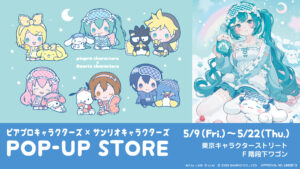
Source:Hatsune Miku official blog
Genre: Plushes, ball-chain mascots, miscellaneous goods
Content:
Hello Kitty dressed in Miku’s outfit
Kitty-face mascots with Miku-style hair and costume
Stationery, pouches, T-shirts, and other apparel and miscellaneous items
Features:
A classic “global character × virtual singer” collab
Small mascots are easy to attach to bags/backpacks and are popular with overseas fans
NewsletterFound this fascinating? Get the free Authenticity Guide.Many items are event-limited or shop-limited — “if you miss it, you might never meet it again”
Recommended points:
Appeals to both Sanrio and Miku fans — great for gifts
Photo-friendly mascots are well-liked for SNS sharing
High-profile Hatsune Miku collaboration projects
1. Good Smile Racing × Hatsune Miku “Racing Miku”
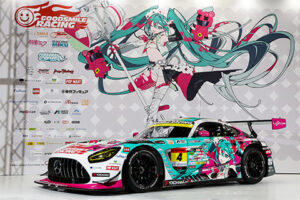
Source:グッドスマイルレーシング
Overview
“Racing Miku” is the mascot for the Hatsune Miku GT Project, a team that competes in SUPER GT. The character acts like a race queen mascot and is the official figure for the race team, appearing on the car, pit area, and merchandise.
Scale
Racing cars are fully wrapped with Racing Miku designs and run at circuits domestically and abroad. New designs are released yearly, spawning figures, goods, and fan merch in large numbers.
Points
A singular project that fuses “itasha (character-wrapped car)” culture with a serious race team. Fans can simultaneously support their favorite driver and Miku, blending race culture and character fandom.
2. Toyota × Hatsune Miku (TOYOTA USA “COROLLA × Miku” campaign)
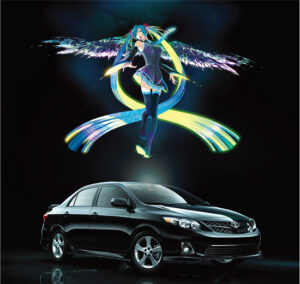
Source:Hatsune Miku official blog
Overview
Toyota in the U.S. used Hatsune Miku in a large promotional campaign for the Corolla, under the concept “Virtual Pop Star × COROLLA.”
Scale
TV commercials, dedicated websites, event appearances — a global brand’s full-scale use of Miku in advertising.
Points
A full-fledged automaker tie-up elevated Miku’s status as a character, giving broader exposure to general audiences in North America.
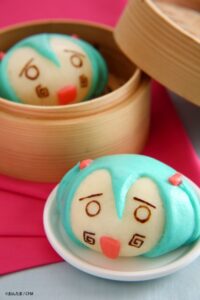
3. FamilyMart × Hatsune Miku (“Miku-man” & fair)
Source:Hatsune Miku official blog
Overview
A collaboration campaign with the convenience store chain FamilyMart, involving in-store fairs, prize draws, exclusive goods, and more across multiple years.
Scale
Implemented nationwide, making Miku visible in everyday retail environments.
Points
“Going to FamilyMart means meeting Miku” experiences spread on social media. The collaboration broadened Miku’s appeal beyond hardcore fans to students, families, and casual consumers.
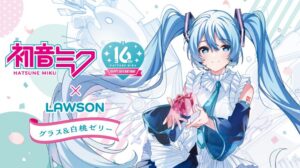
4. Lawson × Hatsune Miku collaboration campaigns
Source:ローソン
Overview
A long-running tie-up with Lawson that repeatedly hosts Miku collaboration fairs. Drawings of Miku in Lawson uniforms and other limited illustrations make each campaign noteworthy.
Scale
Ongoing campaigns producing clear files, tapestries, food tie-ins, and seasonal collaborations like “Snow Miku × Lawson.”
Points
A familiar, almost “standard” collaboration that many fans expect — some treat Lawson as a shrine-like stop when visiting Japan.
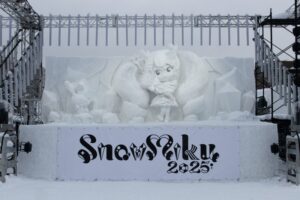
5. Sapporo Snow Festival × Snow Miku (SNOW MIKU)
Source:Hatsune Miku official blog
Overview
An official “Snow Miku” project tied to the Sapporo Snow Festival. Each year a winter-themed Snow Miku is unveiled with a new theme.
Scale
Snow sculptures, live events, train and public-space wraps, and extensive merchandise — turning the city into a Snow Miku experience.
Points
Links character promotion with regional tourism and public engagement. Many overseas visitors plan winter trips to Hokkaido to see Snow Miku events.
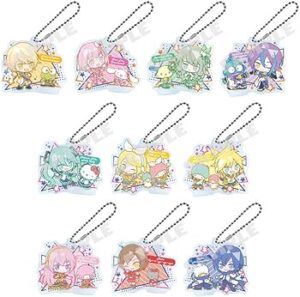
6. Sanrio × Hatsune Miku (Hello Kitty collaboration)
Source:Amazon
Overview
A crossover project pairing Sanrio characters and Hatsune Miku — centered on Hello Kitty × Hatsune Miku goods and events.
Scale
Wide product range: plushes, ball-chain mascots, stationery, apparel, event-limited goods, etc.
Points
A dream combination of “global character × virtual singer” with huge buzz potential. Both Sanrio and Miku fans collect these items as memorabilia of the crossover.
7. Domino’s Pizza Japan × Hatsune Miku (Domino’s app collaboration)
Source:Animate Times
Overview
An AR app–linked promotional project with Domino’s Pizza, combining pizza and an app-based experience.
Scale
Scan a pizza box with the dedicated app to see AR Miku perform on the box. Miku-branded packaging and in-store visual campaigns were also used.
Points
The gimmick “turn the pizza box into a stage” drew big attention domestically and internationally, making headlines as a creative Japan-style marketing stunt.
9. Nissin Cup Noodles × Hatsune Miku / Project SEKAI
Source:日清食品
Overview
A collaboration titled “Cup Noodles × Project SEKAI Colorful Stage! feat. Hatsune Miku.” Announced by press release on February 16, 2022, and followed by a five-day in-game campaign (May 1–5, 2022) that added commemorative songs to the game.
Scale
Original songs themed after Cup Noodle flavors were composed by well-known producers (Mitchie M, DECO*27, PinocchioP, Kanaria, etc.) and added to the rhythm game Project SEKAI as event content.
Points
As a digital-first campaign (music, MV, game), overseas fans could easily participate. The unique concept of Cup Noodle–themed Vocaloid songs generated buzz and reinforced how Japanese corporate tie-ups can create globally shareable content.
About Sanrio
Source:Sanrio
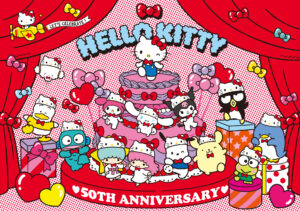
Founded in 1960, Sanrio Co., Ltd. is a character-goods brand company. Its concept is “Small Gift, Big Smile.” Centered on Hello Kitty, Sanrio develops many globally loved character IPs and operates across goods, animation, theme parks, cafes, and corporate collaborations. As a symbol of “kawaii” culture, Sanrio enjoys global popularity.
Sanrio Puroland (Tama, Tokyo)
Source:Sanrio Puroland
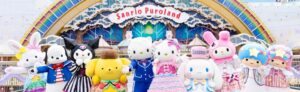
Opened in 1990, an indoor theme park (fun even on rainy days). Features live shows, parades, and character greetings, allowing visitors to experience Sanrio character worlds. It’s a photo-friendly and “oshi-activity” spot popular with younger generations and increasingly a “kawaii pilgrimage spot” for overseas travelers.
Representative popular content:
Miracle Gift Parade
KAWAII KABUKI ~ Hello Kitty Troupe’s Momotaro ~
Photo opportunities with characters and limited-goods shops
Top 5 Sanrio characters popular overseas
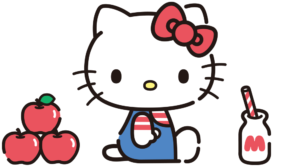
Hello Kitty
Source:Sanrio
Birth: 1974 (Sanrio)
Character summary: A girl from the suburbs of London who is cheerful and curious. Fun trivia: official stats say her weight equals three apples and her height equals five apples.
Popularity in Japan: A long-standing top-tier, multi-generational “national character.”
Why she’s valued overseas:
Recognized globally as the symbol of “kawaii” culture
Collaborates with major high-fashion brands (Balenciaga, Nike, etc.)
Her minimal storyline makes her easy to accept across cultures
Universally usable by children and adults
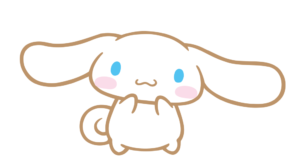
Cinnamoroll
Source:Sanrio
Birth: 2001 (Sanrio)
Character summary: A cafe mascot dog for Café Cinnamon, able to fly with big ears. Fluffy white and light-blue soothing visuals.
Popularity in Japan: Regularly ranks high in the Sanrio Character Ranking; currently one of the most momentum-driven characters.
Why she’s valued overseas:
Perfect fit with Gen Z pastel/aesthetic café culture
Extremely “SNS-friendly” visuals for TikTok/Instagram
A calming “pure/soft/gentle” image that resonates
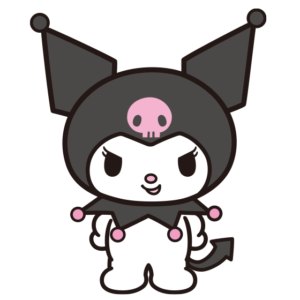
Kuromi
Source:Sanrio
Birth: 2005 (came from the anime “Onegai My Melody”)
Character summary: My Melody’s rival — a mischievous little devil with a delicate, sentimental side.
Popularity in Japan: Exploded among teens and young women; consistent high rank in the character awards.
Why she’s valued overseas:
The “cute × dark” duality is a big draw
Highly compatible with Y2K and subcultural fashion trends
The “cute but edgy” balance aligns with global trends
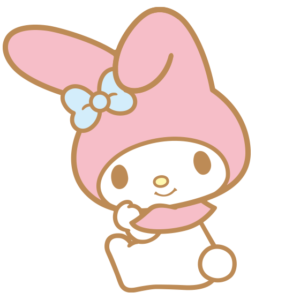
My Melody
Source:Sanrio
Birth: 1975 (Sanrio)
Character summary: Recognizable by her red/pink hood — gentle, pure, and very girlish.
Popularity in Japan: A legendary character behind Hello Kitty, especially beloved by women who grew up in the ’90s and ’00s.
Why she’s valued overseas:
Red/pink + rabbit + ribbon = universally recognized “cute” sign
Feminine and sweet world easily crosses borders
Especially popular in China and Southeast Asia
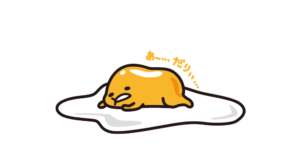
Gudetama
Source:Sanrio
Birth: 2013 (Sanrio)
Character summary: A lethargic egg with a lazy attitude and wry lines.
Popularity in Japan: Viral on social media and spawned cafes and many collabs.
Why he’s valued overseas:
The “don’t try / don’t care” sentiment resonates globally
Strong adult appeal — high purchasing-power target
Fits meme culture well (stickers, GIFs, shareable content)
Summary
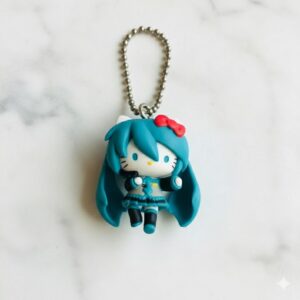
The Hatsune Miku × Hello Kitty Ball-Chain Mascot is:
an originally gacha-released rare item,
an official double-licensed collaboration between Sanrio and Hatsune Miku, and
a pocket-sized “oshi” mascot you can carry every day. Because it was a limited, in-store gacha release, you can’t spin for it at shops anymore — which gives current owners and prospects a special reason to seek it out.
Whether displayed on a collection shelf or hanging from a bag or pouch, it’s an unmistakable “insider” piece. If you love Hatsune Miku, Hello Kitty, or Sanrio collecting, consider welcoming this item into your collection.
▼ HD Toys Store▼
Hatsune Miku × Hello Kitty Ball-Chain Mascot — Vocaloid × Sanrio Collab Cat


Shop Authentic Japanese Collectibles
Shipped directly from Japan. Each item carefully inspected.
Found this fascinating? Get the free Authenticity Guide.
Subscribe for our free Japanese Figure Authenticity Guide (PDF) — spot bootlegs, read maker markings, buy pre-owned with confidence — plus 10% off your first order and weekly deep-dives. No spam, unsubscribe anytime.
Related from Our Store
 | HD Toys Store Japan Hatsune Miku x Hello Kitty Ball Chain Mascot Vocaloid Sanrio Collaboration Cat $124.00 USDOnly 1 left ✓ Authenticated in Japan · ✓ Detailed condition photos · ✓ Worldwide tracked shipping |
コメント