
- Product Information
- A 1990s Fendi Piece, Told in Beads
- The Feeling the Makers Put Into the Mamma Baguette
- Beads as a Material, and Handwork One Bead at a Time
- Clues for Reading the Era
- The Four Places with Fendi Markings
- Size and How to Carry It
- Material and Hardware
- Accessories
- To Keep It With You for Years
- Caring for the Hardware, and Storage
- The Shape That Continues, and This Piece from Its Time
- Current Fendi Models Close to the Mamma Baguette
- The Same Mamma Baguette in Other Colors
- In Closing
Product Information
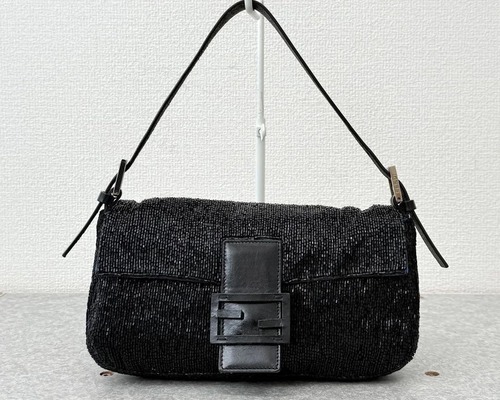
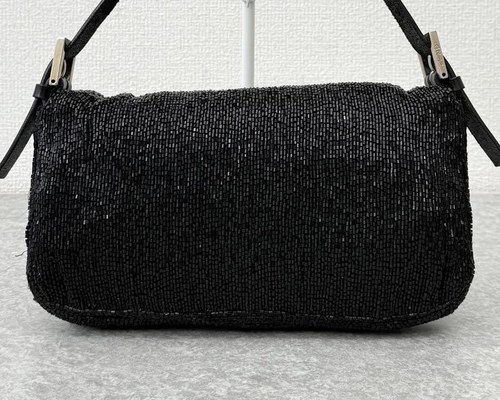
| Item | Details |
|---|---|
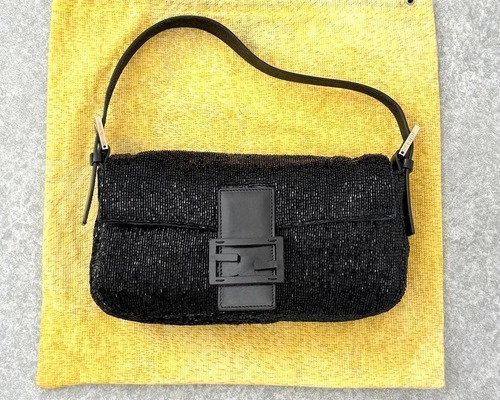
| Product | FENDI Mamma Baguette Beaded Handbag |
| Brand | Fendi (FENDI) |
| Line | Fendi Baguette |
| Color | Black (silver hardware) |
| Material | Exterior: beads and leather / Lining: satin (blue) |
| Size | Approx. W 25 cm x H 12 cm x D 4 cm / handle drop approx. 19 cm (listed size: Medium) |
| Shape | Rectangle |
| Closure | Magnetic |
| Handle | Shoulder strap (leather, black) |
| Hardware | Silver |
| Interior | Inner pocket |
| Country of origin | Italy |
A 1990s Fendi Piece, Told in Beads
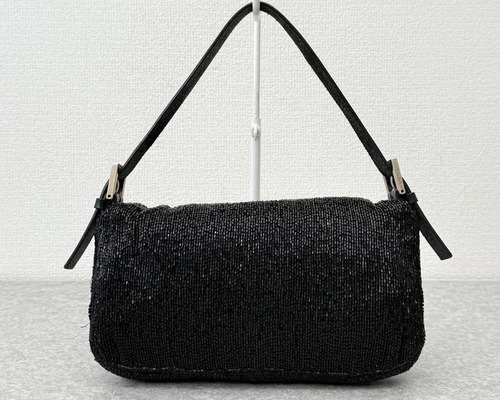
Black beads that quietly shift their expression with the angle of the light. This is Fendi’s Mamma Baguette in an all-over beaded finish.
The Baguette, born in 1997, became one of Fendi’s defining creations. The Mamma Baguette arrived as its sister, and in 2025 it returned as part of the current collection. This piece stands at the origin of a shape that is still being made today in new expressions.
In this article, we look at the feeling behind the bag’s name, where its beaded decoration comes from, where to look to read its era, and how to care for it so that it stays with you for years. We hope it gives anyone searching for a piece from that period the clues to check it with their own eyes.
The Feeling the Makers Put Into the Mamma Baguette
1925: From a Small Shop in Rome
Fendi began in 1925 in Rome, Italy, when Edoardo and Adele Fendi opened a leather goods shop with a fur workshop attached.
It was a shop that started from the handwork of a married couple. Choosing materials, cutting, stitching. They grew the brand while checking each of those steps with their own hands.
* An illustrative image evoking the atmosphere of the period (AI-generated). It does not reproduce any actual shop or product.
The founders had five daughters: Paola, Anna, Franca, Carla and Alda.
As each finished her studies, she joined the family business, and together they lifted a single shop in Rome into a brand known around the world. The reason Fendi has kept the form of a family-run house is that its foundation was laid in these years.
A Granddaughter Gave Her Grandmother’s Name
Then came the third generation. Silvia Venturini Fendi created a single bag in 1997.
The idea came from the sight of people in France carrying a baguette tucked under one arm: a horizontal form that sits neatly at the side, and a short strap. In an era when minimalism was the mainstream, Fendi used this small bag to raise a flag against the aesthetics of the time. Moving away from clean, monochrome design, it declared itself “unconventional” through bold color combinations, craftsmanship and inventive use of materials.
The Baguette sold more than 100,000 pieces in its first year, and later came to be called the world’s first “It bag.”
That Baguette is still being made today under the name “Baguette® 26424.” The photograph below shows the current model in black crackle leather.
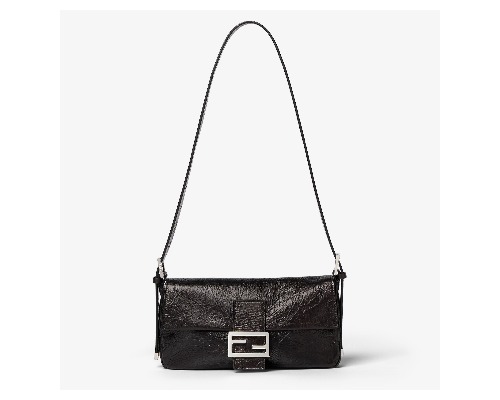
Image source: FENDI official website
https://www.fendi.com/jp-ja/
A slightly larger sister was then born to that Baguette: the Mamma Baguette.
Mamma means “mother” in Italian. Being larger than the Baguette, it was called the mother of the Baguette, and at the same time it was named as a tribute to the founder, Adele Casagrande Fendi.
A granddaughter gave her grandmother’s name to a bag. The name of this bag is itself a form of respect carried across three generations of one family.

Reference: FENDI official website, The Baguette® 26424
https://www.fendi.com/jp-ja/cm/articles/the-baguette-26424
Beads as a Material, and Handwork One Bead at a Time
Not Decoration, but a Statement
The Baguette and the Mamma Baguette have appeared in more than 1,000 variations, changing material and decoration: canvas, leather, silk, denim, fur, embroidery, sequins and beads.
This is not simply a story of releasing many versions. Fendi itself describes the Baguette as “an unconventional manifesto of vivid craftsmanship and inventive use of materials”. Beads were not decoration; they were the brand’s statement itself.
The current Mamma Baguette also comes in a version covered with beads and sequins. The stance of making the decoration itself the lead has not changed.
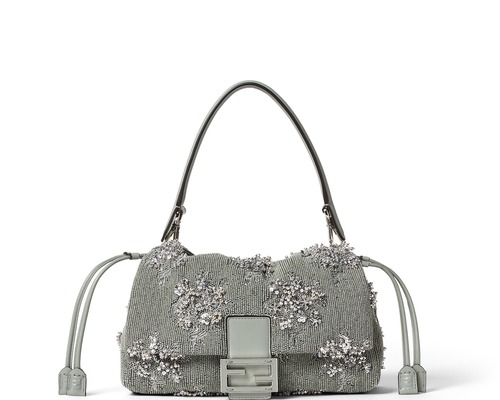
Image source: FENDI official press release (February 5, 2025)
https://prtimes.jp/main/html/rd/p/000000489.000003876.html
Stitched One Bead at a Time by Hand
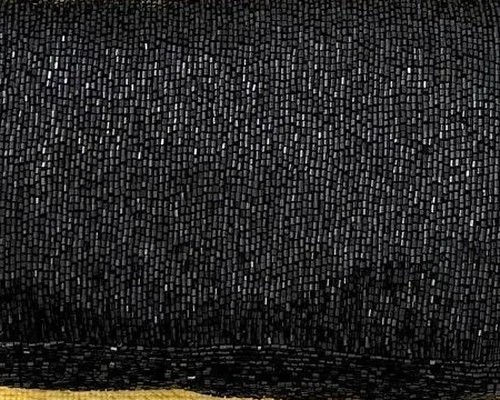
The beaded versions are made entirely by hand embroidery. Beads that differ in shape and size are stitched down one at a time with thread by an artisan, building up the surface.
Fendi has insisted on finishing this kind of decoration through the hands of its artisans. In an era when minimalism was the mainstream, choosing decoration that takes this much time was a deliberate act. Because this is a house that began with the handwork of a family, that choice carries meaning.
The photograph below shows a Fendi artisan finishing a Mamma Baguette. The process of shaping it with tools and hands alone is still carried on today.
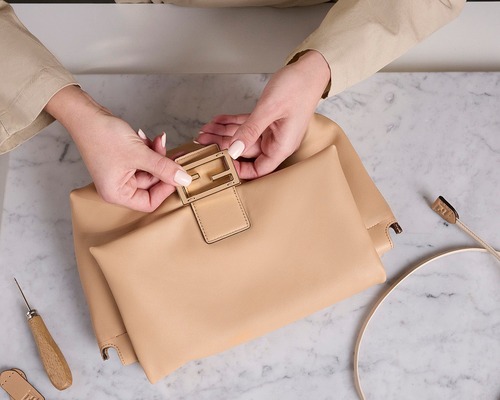
Image source: FENDI official press release (February 5, 2025)
https://prtimes.jp/main/html/rd/p/000000489.000003876.html
Which Is Why No Two Pieces Look Alike
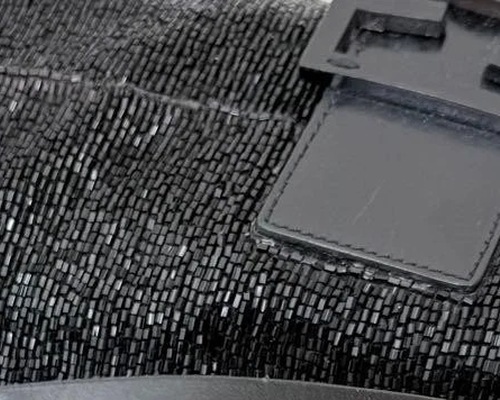
Beads stitched down by hand have a density that machines cannot produce, and a slight irregularity. Even when the surface looks uniformly black in a photograph, light reveals fine shadows that follow the rows of beads.
Fendi itself notes the following.
Slight differences in appearance are inherent characteristics that give the item its individuality and value.
Even within the same specification, no two pieces are exactly alike. Choosing a beaded piece also means choosing the expression that belongs to that individual bag alone.
Clues for Reading the Era
The Number Marked on the Lining
When you look for vintage, you start to wonder when a piece was actually made. This bag has left several clues for that. Knowing where they are lets you estimate the era yourself.
On this bag, the serial number is marked directly on the satin lining inside.
What is marked is a sequence of numbers divided by slashes. Rather than on a leather tag, it is stamped on the lining itself, which is characteristic of Fendi in this period. You can check the actual sequence in the photographs on the listing page.
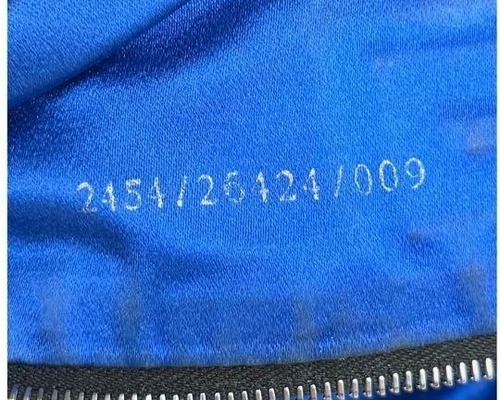
Fendi currently offers the Baguette under the name “The Baguette® 26424” . The same figures appear in the title of the feature page on its official website.
And in the number marked on this bag’s lining, the same figures appear in the middle. Please enlarge the photograph to check.
A piece made nearly thirty years ago and today’s official page are connected by the same figures. We think it is the clearest clue you can verify with your own eyes.
The Era of Holograms and RFID
There is one more clue that helps with dating.
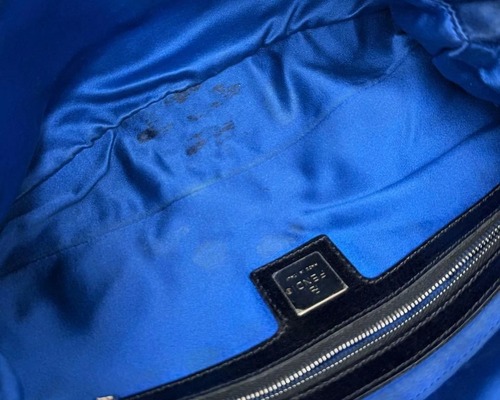
From 2004 onward, Fendi began placing a hologram tag inside its bags. In addition, from 2010 an RFID chip was added for authentication.
In other words, if these are present, the piece was made in or after 2004. Conversely, it is natural for a piece from the 1990s to have neither.
That said, their absence alone does not determine the era. It is one point to look at alongside the other clues.
The hologram and RFID tags would be placed on this inner surface. This piece has neither.
The Four Places with Fendi Markings
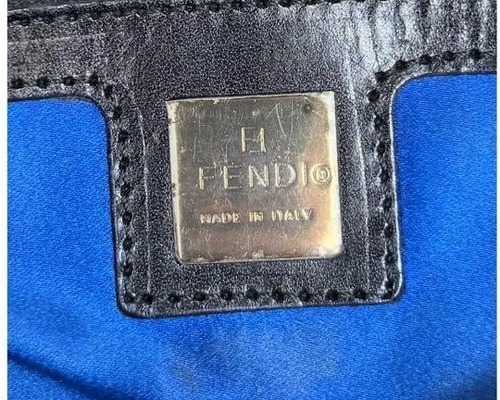
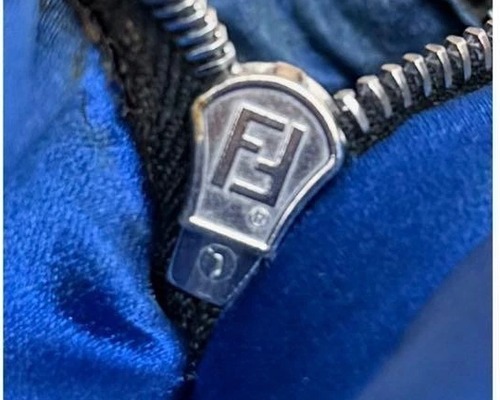
This bag carries Fendi markings in four places. You can enlarge each of them in the photographs on the listing page.
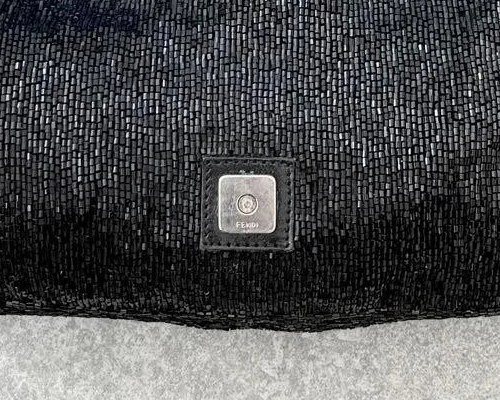
The square metal plate inside: FF logo, FENDI, MADE IN ITALY
The zipper pull: FF logo
The buckle hardware on the shoulder strap: FENDI
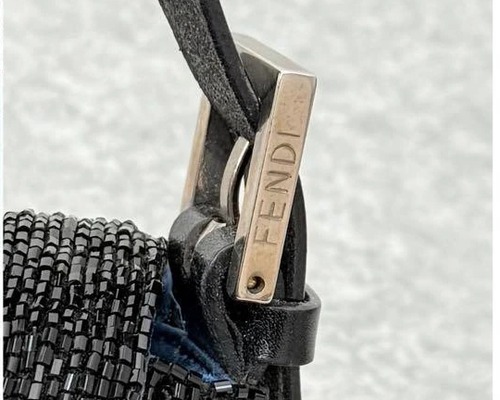
The satin lining: the serial number (a sequence of digits separated by slashes)
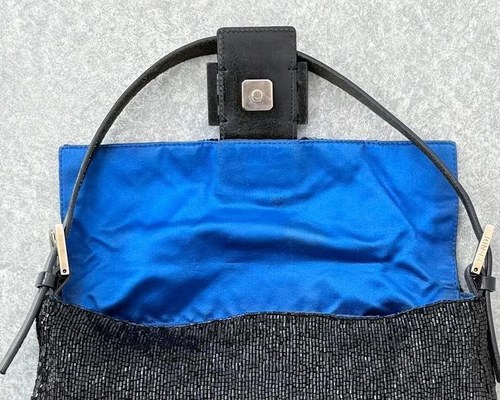
Please note that the color and material of the hardware vary by model. Some are gold and some, like this piece, are silver, and the color itself does not indicate the era or authenticity. What to look at is not the color but whether the markings and wording are there.
Size and How to Carry It
The width is about 25 cm (about 9.8 inches), the height about 12 cm (about 4.7 inches), and the depth about 4 cm (about 1.5 inches). The handle drop is about 19 cm (about 7.4 inches), so the bag sits neatly at your side when carried on the shoulder.
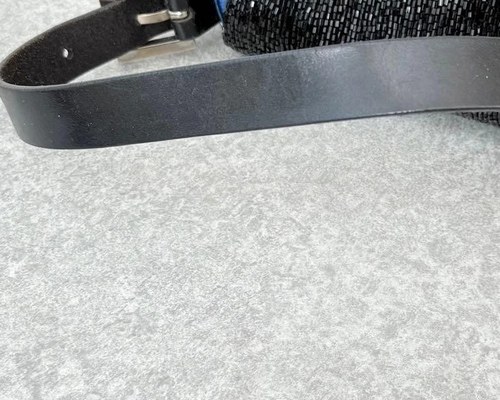
The shoulder strap is buckled and adjustable in length.
The idea behind the original Baguette, to be tucked under one arm, is expressed directly in these proportions. Because the form is horizontal and slim, it does not break the line of what you are wearing.
Material and Hardware
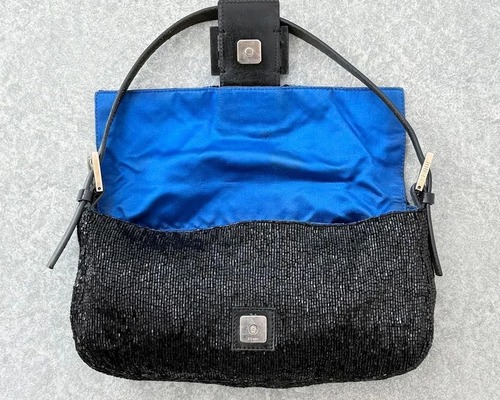
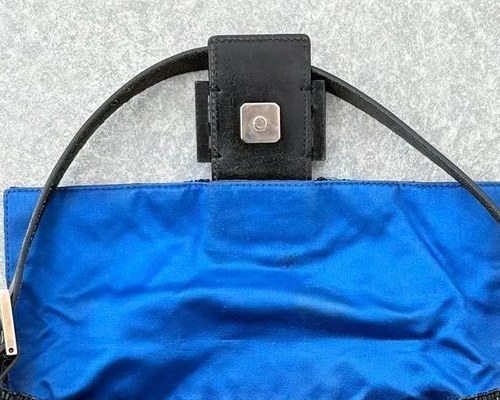
The exterior is beads and leather. Leather is used for the strap and flap, and the body is covered with beads. The lining inside is satin, in blue. The blue that appears when you open an exterior of solid black is, we think, a hidden highlight of this bag.
The hardware is silver and the closure is magnetic. Inside there is a zipped pocket. The country of origin is Italy.
Accessories
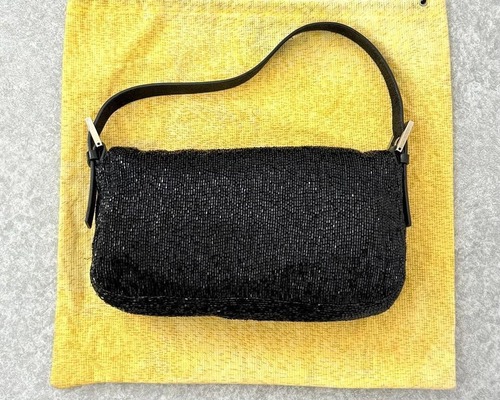
The original storage bag (dust bag) is included. The condition is Pre-owned (Good); for details of the condition, please check the photographs on the listing page, where many images of the actual item are shown.
To Keep It With You for Years
How should you handle it after it reaches you so that you can enjoy it for a long time? Here is what Fendi advises officially, part by part.
For embroidery, Fendi recommends protecting it from rubbing and impact in order to preserve its beauty. It also advises taking particular care during use so that the decoration is not damaged or detached.
The beads are stitched down one at a time. It is safer to avoid carrying the bag together with garments that have hook-and-loop fasteners, or with bags that have exposed hardware.
For the leather used on the strap and flap, Fendi recommends protecting it from knocks and scratches. Handcrafted leather differs in expression from piece to piece, and that in itself is considered the character of the item.
Caring for the Hardware, and Storage
For the hardware, Fendi recommends wiping the surface with a soft, dry cloth. It advises avoiding knocks and rubbing and, when necessary, washing with water and a mild detergent, then polishing with a dry microfiber cloth.
For storage, it advises keeping the bag in its protective case (dust bag), in a dry place, away from heat sources and direct light. Protecting it from rain is also stated. Prolonged exposure to extreme weather can lead to changes in color and yellowing.
And Fendi gives the following guidance.
Avoid contact with alcohol and solvents (perfume, nail polish remover and the like), oils, grease and abrasives. They may alter the condition of the product irreversibly.
Reference: FENDI official Product Care
https://www.fendi.com/sustainability/en/product-care/leather-goods
The Shape That Continues, and This Piece from Its Time
2025, the Year of the Centenary
The Mamma Baguette returned as part of the current collection in February 2025. It appeared on the Spring/Summer 2025 runway and has drawn attention once again.
2025 was also the year Fendi marked its 100th anniversary. A bag that carries the name of the founder, Adele, came back at that hundred-year milestone. There is a story here that feels very much like this house.
Since then, new Mamma Baguettes have continued to be made in changing materials and expressions. In the 2025 announcement, this bag was introduced as “a timeless It bag”. A shape that does not age as the times change, in other words.
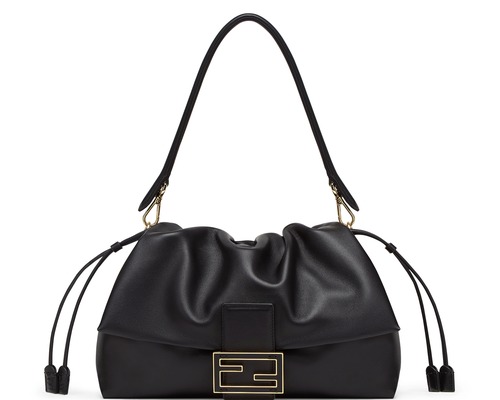
Image source: FENDI official press release (February 5, 2025)
https://prtimes.jp/main/html/rd/p/000000489.000003876.html
A Piece Made in Its Own Time
With all of that said, there is something only this one piece has.
It is that it was actually made in the 1990s. It was finished with the materials and the handwork of that time, and nearly thirty years have passed since. That time alone cannot be reproduced by a revival made new.
Because the same shape is still being made today, the meaning of a piece that stands at its origin stands out all the more. For those looking for the original rather than the revival, pieces like this do not come along often.
Current Fendi Models Close to the Mamma Baguette
For those drawn to this shape, here are three models in Fendi’s current line-up with a similar feeling. All are current products offered on the official website.
Baguette® Soft Small
A Baguette finished in soft nappa leather with a rounded silhouette. It is the closest to the draped feeling of the Mamma Baguette.
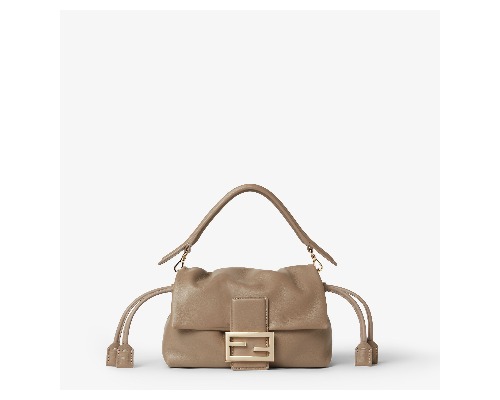
Image source: FENDI official website
https://www.fendi.com/jp-ja/
Peekaboo ISeeU Petite
Another of Fendi’s icon bags. This one is made in the Selleria technique with 306 hand-sewn topstitches, and shares with the beaded piece the quality of artisan handwork.
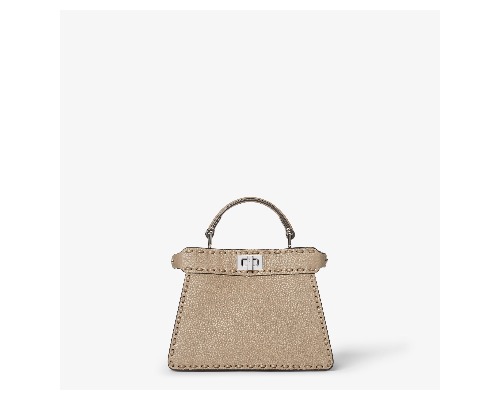
Image source: FENDI official website
https://www.fendi.com/jp-ja/
By The Way Selleria Medium
A model with a horizontal form that can be carried tucked under the arm. It is also finished in the hand-sewn Selleria style.
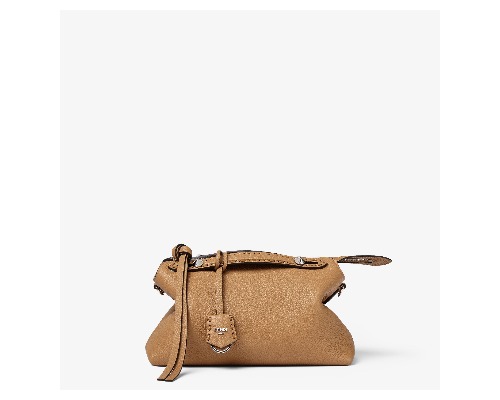
Image source: FENDI official website
https://www.fendi.com/jp-ja/
The Same Mamma Baguette in Other Colors
The Mamma Baguette, revived in 2025, is offered in several colors. Here are three of them, to show how the same shape changes with color. Please note that the beaded version is a single piece exclusive to the Matsuya Ginza store in the 2025 line-up, and is not offered in other colors.
Large (H 22 x W 31.5 x D 12 cm)
A calm, greige-like tone. It shows the drape of the soft leather most clearly.
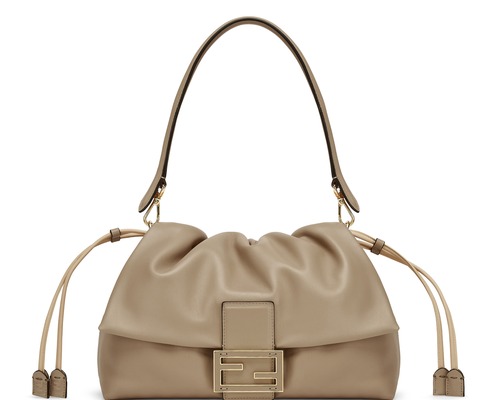
Image source: FENDI official press release (February 5, 2025)
https://prtimes.jp/main/html/rd/p/000000489.000003876.html
Medium (H 18 x W 26.5 x D 8.5 cm)
A pale, greenish tone. One size smaller, with a clean, neat impression.
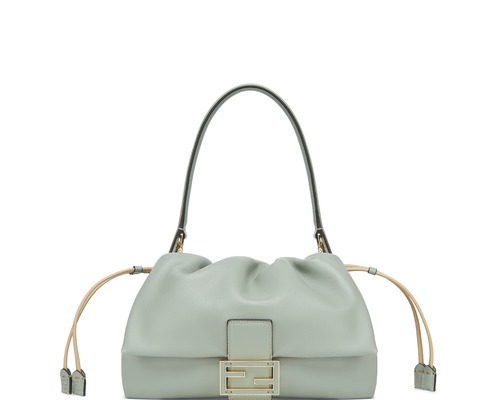
Image source: FENDI official press release (February 5, 2025)
https://prtimes.jp/main/html/rd/p/000000489.000003876.html
Medium (H 18 x W 26.5 x D 8.5 cm)
A light, beige-like tone. In contrast to black, it gives a lighter impression.
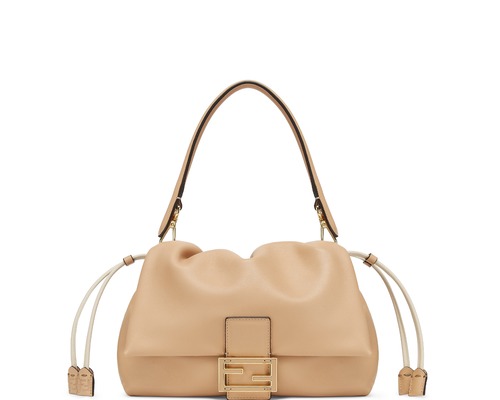
Image source: FENDI official press release (February 5, 2025)
https://prtimes.jp/main/html/rd/p/000000489.000003876.html
In Closing
A brand that began in 1925 from a single shop in Rome. A bag raised by five daughters and given a grandmother’s name by her granddaughter. Beads stitched down by hand, one at a time. And nearly thirty years of time.
Quietly black to the eye, yet every bead answers when the light reaches it. The expression of handwork, of which no two are ever the same, belongs to this one piece from that period alone. The clues to its era and the photographs of its condition are all here for you to check. We would be delighted if you looked with your own eyes and then welcomed it into your hands.
▼ HD Fashion & Sports ▼
FENDI Mamma Baguette Beaded Hand Bag Black Rare Vintage Shoulder Bag Purse Women


コメント