By Mitsuru Harada | Published: November 22, 2026 | Last reviewed: November 2026
Some cards are bought to be played, and some are bought to be kept. A Mox Diamond from the Stronghold set often falls into both camps, which is why handling a copy calls for the same care whether it is headed for a deck box or a display frame. This listing covers a single Mox Diamond card from Stronghold, published by Wizards of the Coast. In this guide I explain the franchise behind the card and walk through the inspection habits I use before a card like this changes hands.
Cards that come through the Japanese collecting scene often arrive with a clear storage history. Many Japanese collectors sleeve, toploader, and box their cards as a matter of routine, and they usually keep them away from sunlight and humidity. This care does not change what a card is. It does change what you are likely to find when you take it out of the sleeve. A card from a collection kept this way tends to show its edges, corners, and surface as they were preserved, which makes inspection simpler and more honest for both parties.

About This Item
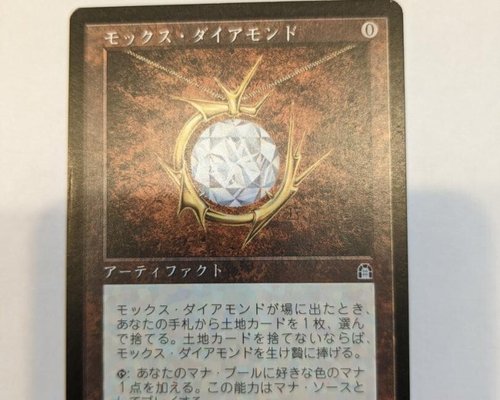
This is a single Mox Diamond card from the Stronghold set, published by Wizards of the Coast. It is an artifact card, and it belongs to Magic: The Gathering, the collectible card game designed by Richard Garfield. The listing is for one card only. It does not include a booster pack, a deck, a binder, or any other bundled item, so the card itself is the whole focus of the purchase.
The card is offered in pre-owned condition. We inspected it under even lighting before listing and looked at the front face, the back, all four corners, and the full length of each edge. A pre-owned card has a history, and part of our job is to describe that history plainly. The listing photos are there to show the actual card you would receive, not a stock image. I recommend studying every photo closely before you decide. Pay particular attention to the back border, because that is often where handling wear shows first.
Stronghold cards carry the set’s expansion symbol on the card face. That symbol is a useful reference point when you compare a copy against reference images of the set. If you want to cross-check the card name, set, and printed details, a public card database is a sensible step for any careful buyer.
Key Details
- Manufacturer: Wizards of the Coast
- Series/Franchise: Magic: The Gathering, Stronghold set
- Type: Trading Cards
- Condition: Pre-owned, inspected before shipping
- Origin: Japan


The Magic: The Gathering Franchise: Why Collectors Care
According to the Magic: The Gathering reference on Wikipedia (https://en.wikipedia.org/wiki/Magic%3A_The_Gathering), the game was created by Richard Garfield. It exists as a collectible game, a tabletop game, and a digital collectible card game. That origin explains why collectors pay so much attention to early sets and to the publisher’s name on a card. Magic was the starting point of a whole category for Wizards of the Coast.
The game went through a major expansion phase later on. As reported by the same Wikipedia reference, over twenty billion Magic cards were printed between 2008 and 2016 as the game grew in popularity. That number puts any single older card in perspective. The game produces an enormous volume of cardboard, so collectors learn to look closely at specific sets, specific cards, and specific copies rather than treating the game as one undifferentiated pile.
The player base is the other half of the story. According to the Wikipedia reference, Magic had reached approximately fifty million players worldwide by 2023. A game with that reach creates a community in which cards circulate constantly. They are traded at local stores, sold between collectors, and passed down from older players to newer ones. In my experience, that constant circulation is why condition and handling history matter so much. Every copy of a well-known card has passed through different hands, and those hands leave different marks.
For collectors, this card brings together the publisher’s first trading card game, a game designed by Richard Garfield, and a named expansion set. You can trace those three threads directly through the card in front of you.
Rarity and Value Factors
I am not going to make claims about print runs, scarcity, or pricing for this card. Those details are not part of what I can source here. What I can do is explain the factors collectors generally weigh when they compare one copy of a card with another, because those factors apply to this card directly.
The first factor is condition consistency across the whole card. A clean front means little if the back shows heavy edge whitening. The second is surface integrity: scratches, print lines, indentations, and clouding on the gloss. The third is structural flatness. Cards stored in humid places can warp, and a curved card behaves differently in a sleeve and in a frame. The fourth is storage history. A card that spent years in a sleeve and toploader usually shows less handling wear than one shuffled loose in a deck.
Finally, collectors care about transparency. Clear, unedited photos and a plain description of flaws give a buyer what they need to judge a copy fairly. That is the approach we take with every listing.

Looking for this item? Every item at HD Toys Store Japan is:
- Shipped directly from Japan with tracking
- Carefully inspected for condition and authenticity
- Pre-owned condition documented with detailed photos
Collector’s Guide: What to Look For
When I handle a single card from an older set, I follow the same routine each time.
- Use the right light: I start under a neutral, diffused light and look at the card flat. Then I tilt it slowly so the light rakes across the surface. Raking light reveals what flat light hides: fine scratches, roller marks, small dents, and areas where the gloss has dulled.
- Check the back first: The back of a Magic card has a dark border that shows wear quickly. Edge whitening and corner fraying stand out there long before they become visible on the front. Look at all four edges, not just the corners, because shuffling tends to chip the long edges along their full length.
- Check flatness: Lay the card on a clean, flat surface and look at it from the side at eye level. A slight bow is common in older cards and is not always a dealbreaker, but you should know about it before you buy.
- Compare the printed details: Check the card name, the expansion symbol, the text box, and the frame against a public reference image of the Stronghold printing.
- Ask for what you need: If a listing photo is unclear, ask the seller for another angle.
We tested our own photography setup with these same angles in mind, so the listing images show the back, the corners, and the surface under directional light.
Condition Checklist
- Back border and edges: Inspect the dark back border first for whitening, nicks, and chipping along all four sides. This is the quickest indicator of how much a card was shuffled and played.
- Corners: Check each corner for rounding, fraying, or soft creases. Look closely at the very tip, since slight separation of the card layers can begin there.
- Surface: Tilt the card under light to find scratches, scuffs, print lines, fingerprints, or dull patches on both the front and back.
- Creases and bends: Look for creases, which are permanent, and for bends or warping, which may be minor. Check the card from the side to confirm whether it lies flat.
- Packaging: Single cards do not come with retail packaging in the way boxed collectibles do. What matters most is protective storage, such as a sleeve, a toploader, or a semi-rigid holder. A card shipped in proper protection arrives in the condition shown.
What Changes a Collector’s Interest
For single cards, completeness means something different than it does for boxed figures or games. There is no manual and no box. The card is the entire item. Interest therefore depends almost entirely on the physical state of that one piece of cardboard and on how clearly that state is documented.
Storage history is the factor I find buyers ask about most, and with good reason. A card kept sleeved and away from moisture has had a quiet life. A card that was played heavily, stored loose, or kept in a damp room tends to show it. Wear concentrated on the back usually points to shuffling, while surface clouding can point to humidity.
Clear documentation also matters. Photos of both faces, close-ups of the corners, and an honest note about any flaw make a pre-owned card far easier to evaluate. When those are missing, cautious collectors reasonably hold back.

- Other cards from Stronghold: Collecting by set is a satisfying way to build a focused binder, and the shared expansion symbol gives the collection visual consistency.
- Other artifact cards across Magic: The Gathering: Artifacts form a distinct card type, and some collectors organize entire binders around them.
- Placing a Stronghold card beside earlier and later printings makes those design shifts easy to see.
- Protective and display supplies: Quality sleeves, toploaders, and UV-resistant display frames help keep a card in the condition you received it.
You can browse more collector guides on our blog for inspection and storage advice across other categories.

Why Buy Japanese Collectibles from Japan?
Many collectors in Japan treat preservation as part of the hobby itself. Cards are commonly kept sleeved, stored upright in boxes, and kept away from direct sunlight. Japanese homes and shops also tend to be careful about humidity during the rainy season. Those habits leave a clear storage history that a buyer can read in the card.
Buying from a seller in Japan also means dealing with someone who has seen how collections there are typically kept. In my experience, that background helps when we describe condition, because we know which kinds of wear to look for and how to photograph them.
Every item we list is carefully inspected and then shipped from Japan in protective packaging suited to its type. For a single card, that means a sleeve and rigid protection so it cannot bend in transit. If you have questions about a specific card’s condition, its photos, or how it will be packed, please contact our team before purchasing. We are happy to provide more detail. Please also refer to our returns policy, which explains how we handle inspection concerns after delivery.


Summary
Today Magic is a game with approximately fifty million players worldwide, and single cards from its history continue to circulate among them. This copy is offered in pre-owned condition, carefully inspected under directional light, and documented with photos of the actual card. Whether you plan to sleeve it for play or frame it for your shelf, take the time to study the edges, corners, and surface.
Author: Mitsuru Harada. Last reviewed: November 2026. For questions about this card, please contact us directly.

Explore related collections
Never Miss New Arrivals from Japan
We add new pre-owned figures, toys, and collectibles every week. Sign up to get notified about new items, collector guides, and exclusive updates.
Free · No spam · Unsubscribe anytime

コメント