That small fraction printed on the corner of a Japanese figure box does more work than most collectors realise. Understanding 1/7 figure size, along with its neighbours 1/4, 1/6, 1/8 and 1/10, is the difference between a shelf that looks curated and one where every new arrival fights its neighbours for space. The number is not a quality mark or a price bracket; it is pure arithmetic, expressing how tall the figure is compared to the character at full human height. Divide roughly 160 cm by the scale and the resulting height tells you whether a piece will tower over your existing display, sit comfortably alongside it, or vanish behind a taller companion. That has practical consequences for shelf depth, lighting, shipping box dimensions, and even how much you should expect to pay, since larger scales demand more resin, more paint work and more storage on the retailer’s end. This article breaks down each of the common scales with real measurements, then places them next to live inventory counts and current price ranges drawn from actual listings rather than guesswork or aggregated market data. By the end, readers should be able to glance at a box, picture the finished piece on their own shelf, and judge whether a new figure will harmonise with what they already own or throw the whole arrangement out of proportion before the parcel even arrives.
Almost every boxed Japanese figure carries a fraction somewhere on the box — 1/7, 1/8, 1/4. It is not a quality grade and it is not a price tier: it is simply the ratio between the figure and the character at full size. A 1/7 figure is one seventh of the height the character would be in real life. That single number decides how much shelf you need, how the piece reads next to the rest of your collection, and how big a box has to travel to reach you.
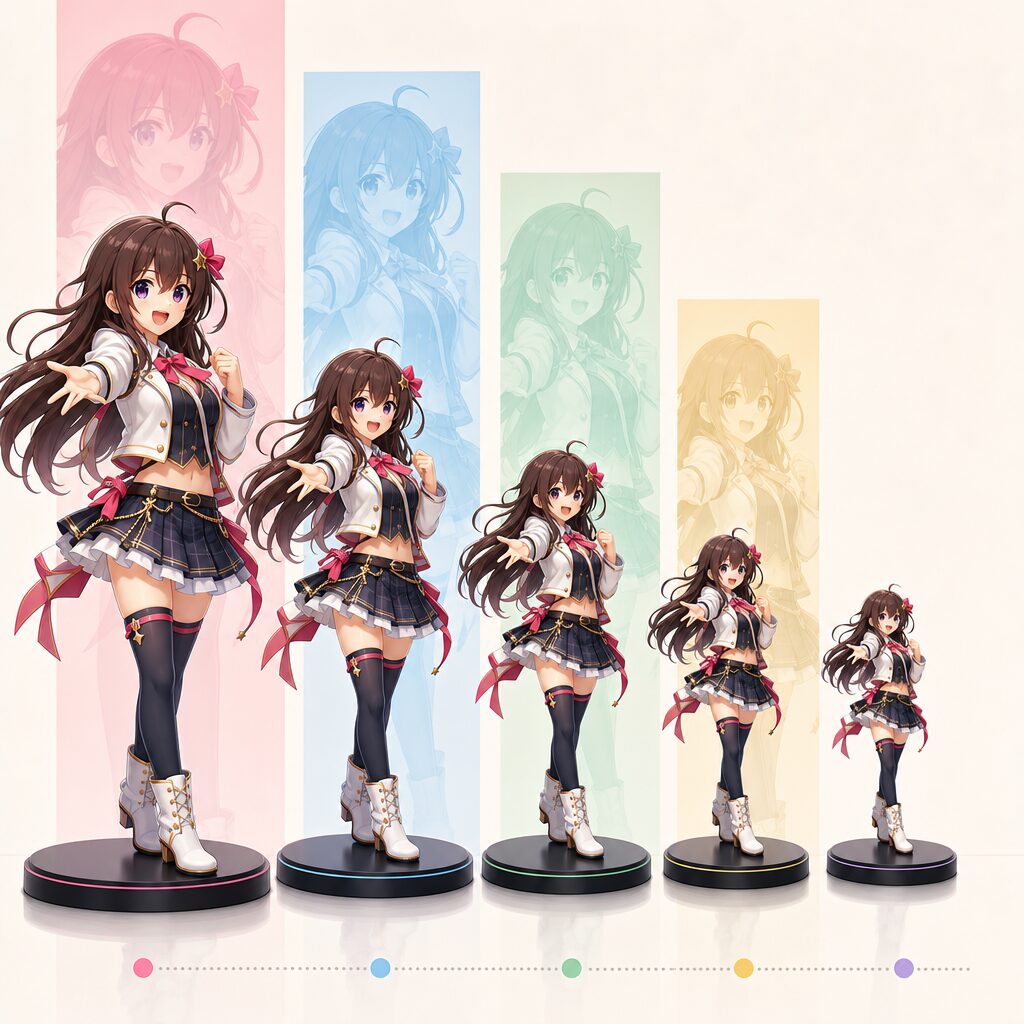
The table below lays the common scales side by side. The height column is arithmetic, not a specification we looked up: it is what you get when you divide a 160 cm character by the scale. The last two columns are our own current stock — how many pieces at that scale we physically have, and the price range of those actual listings.

Japanese figure scales at a glance
Sort by any column, or type in the filter box to narrow the rows. The last two columns are live counts from our own shelves — not a market index, just what we physically have listed right now.
| Scale | What the ratio means | Approx. height (160 cm character) | Shelf space | Commonly used for | Our listings (USD) | In stock now | Browse |
|---|---|---|---|---|---|---|---|
| 1/4 | A quarter of life size — the largest scale in general release | about 40 cm / 16 in | Deep shelf or a cabinet of its own | Flagship centrepiece pieces | $956–$3,917 (6 listings) | 6 | See these → |
| 1/6 | One sixth of life size | about 27 cm / 10 in | Tall shelf, usually a dedicated slot | Large statues and many collectible dolls | $468–$2,771 (20 listings) | 20 | See these → |
| 1/7 | One seventh of life size — one of the two most common figure scales | about 23 cm / 9 in | Standard display shelf | Mainstream scale figures | $258–$1,911 (9 listings) | 9 | See these → |
| 1/8 | One eighth of life size — the other very common scale | about 20 cm / 8 in | Standard display shelf | Mainstream scale figures, often slightly cheaper to ship | $253–$2,159 (13 listings) | 13 | See these → |
| 1/10 | One tenth of life size | about 16 cm / 6 in | Fits a normal bookshelf row | Compact statue lines | $863–$2,675 (3 listings) | 3 | See these → |
| 1/12 | One twelfth of life size | about 13 cm / 5 in | Small — several fit one shelf | Poseable action-figure lines and accessory sets | $1,414 (1 listing) | 1 | See these → |
How the height column was produced: we divided a 160 cm character by each scale. Nothing else was assumed. Real figures differ from that number in both directions — a character who is taller or shorter than 160 cm scales accordingly, a kneeling or crouching pose measures well under it, and a base, wings or flowing hair can push the boxed height well over it. Always read the height printed on the specific listing; the scale tells you the family a figure belongs to, not its exact centimetres.
Which scale should you buy?

Start from the shelf, not the figure. If you display in a standard bookcase, 1/7 and 1/8 are the sizes the hobby is built around — the widest choice of characters, and a height that sits next to other pieces without dominating them. If you want one piece to be the room’s centrepiece and you have a deep cabinet, 1/6 and 1/4 are where that lives. If shelf space is what you are short of, 1/10 and 1/12 give you the same character in a footprint you can actually fit.
Mixing scales on one shelf is normal, but it is worth knowing what it looks like: a 1/4 piece next to a 1/12 piece is roughly a three-to-one height difference, so collectors often group by scale rather than by series.
Scale is not a grade

A larger scale is not automatically a better sculpt, and a smaller one is not a lesser version — they are different products aimed at different display situations. Condition, completeness of the box and its inserts, and whether the piece has been kept out of direct sunlight matter far more to what you actually receive than the fraction on the box does. Those are the things we photograph and describe on each listing.
One practical consequence of scale that is easy to forget: a bigger figure means a bigger, heavier box, and shipping from Japan is charged on the weight of the parcel. If you are buying several pieces, ordering them together means they are weighed and sent as one parcel rather than several.
If what you are weighing up is condition rather than format, our condition and market liquidity guide and the value simulator both work from our own recorded sales, with the sample size shown next to every figure.
See these in stock, or ask us to find one
We currently have 52 scale figures and statues on the site, every one of them pre-owned, inspected by hand in Japan and photographed as it actually is. Browse them here →
If the exact version you want is not there — and with one-of-a-kind secondhand stock it often is not — tell us what you are after on our sourcing request page and we will look for it through our Japanese supply channels. You can also browse the demand catalogue to see what we actively source.
Published: 2026-08-06 · Updated: 2026-08-06 · by HD Store Japan. Product-line characteristics describe the lines in general; individual items vary. Price figures are our own current listings and recorded sales, shown with sample sizes as a reference — not a guaranteed valuation. Every piece we list is an authentic, pre-owned Japanese collectible, inspected hands-on in Japan and shipped from Japan. Questions? See our returns policy or contact us.

コメント