Japanese retro games reach collectors abroad in a way modern releases never do: one physical object at a time, decades after it left the factory, described by somebody you cannot stand next to. Two things decide whether that goes well. The first is what the last thirty years in a Japanese cupboard did to the object. The second is whether the format will actually run on the hardware you own.
This guide covers both. It is deliberately not a general buying guide — for what completeness means in this market, including boxes, manuals and spine cards, our existing games collecting guide already covers that ground and we are not going to repeat it here. What follows is the part that is specific to old Japanese hardware and media: the damage you should be looking for in the photographs, the compatibility questions that catch people out, and what we do and do not verify before something ships.
One note before the detail. We publish no estimates for the wider market and no figures for what any condition is supposed to do to a price. Where this guide talks about condition it is talking about what is physically wrong with an object and how to see it, not about what anyone should pay.
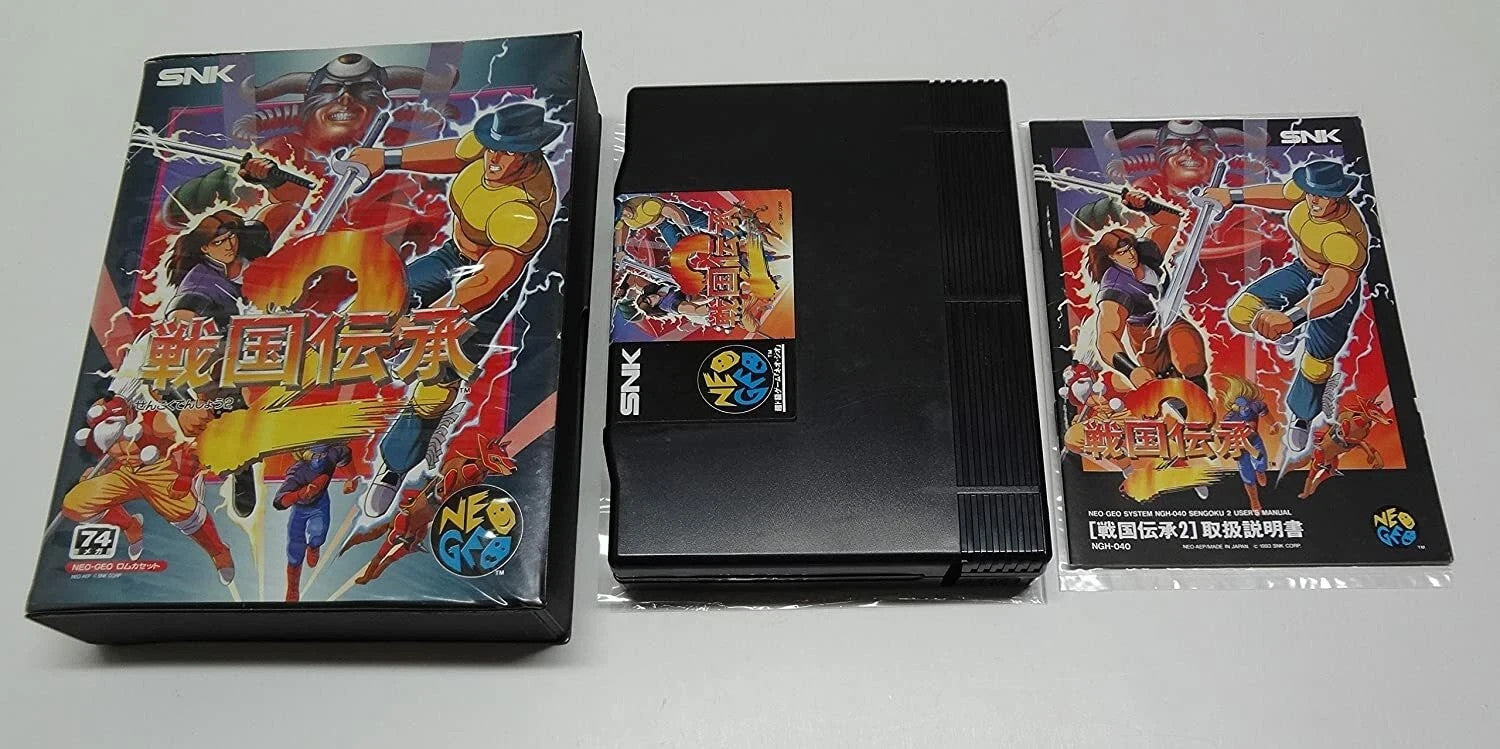
About the photographs in this guide: every image below is our own photograph of an actual item we are holding in Japan right now, linked to its listing. They are there to show the formats being discussed. They are not photographs of the specific damage described in the text, and we do not publish staged or computer-generated images of defects or of our inspection process.
- Battery leakage: the one that quietly destroys the cartridge
- Mould, damp and paper: the parts that do not survive a Japanese summer
- Yellowing and sun damage: what it is, and what it is not
- Region compatibility, format by format
- Completeness: what we mean by it, briefly
- What we actually check, and what we actually guarantee
- Japanese games and consoles we are holding right now
- If the piece you want is not listed
- More in this series
Battery leakage: the one that quietly destroys the cartridge

A large number of Japanese cartridge-based games from the Famicom, Super Famicom, Game Boy and Mega Drive era save progress to on-board memory backed by a small coin cell soldered inside the cartridge. Those cells were specified for a working life measured in years, not decades. Many have long since gone flat, which by itself is unremarkable and repairable. The problem is the ones that leaked.
A leaking cell puts electrolyte onto the board, and the residue keeps corroding traces and solder joints for as long as it stays there. Caught early it is a cleaning job. Left alone it eats through traces, and at that point the board needs repair rather than a battery swap.
What to look for in listing photographs:
- Any staining or crust on the board around the cell — typically whitish, greenish or blue-green residue.
- Discolouration on the cartridge shell near the battery position, which can be visible from outside even when the shell has not been opened.
- Dull, dark or pitted contacts on the edge connector, as distinct from the ordinary light tarnish that most old cartridges carry.
- Whether the seller shows the inside at all. On a battery-backed title, photographs of the board are the ones that answer the question. A listing that shows only the label has not told you.
Two honest caveats. Not every cartridge has a save battery — plenty of titles use password saves or no saving at all, and those cannot have this problem. And a cartridge whose cell has simply gone flat without leaking still plays; it just will not retain a save. Those are different situations and worth separating before you rule a listing out.
Mould, damp and paper: the parts that do not survive a Japanese summer

Japan is humid through the summer, and the material that suffers is paper and anything with an adhesive or a coated surface: manuals, inserts, spine cards, the printed sleeves on optical media, and the boxes themselves. Cartridges and plastic shells generally cope. The paperwork often does not.
What that looks like:
- Foxing — small rust-brown speckles spreading across manual pages and inner sleeves.
- Cockling and waviness in pages and cardboard, which is the trace of moisture the paper absorbed and then lost.
- Grey, green or black patches on card and paper surfaces, and along box seams and corners where air moves least.
- Cloudy haze or fine radial marks on disc surfaces. Optical media stored damp can develop surface deposits, and the layer under the label side is the fragile one.
- Adhesive failure — lifting labels, separating box seams, a jewel case whose paper insert has bonded to the plastic.
Mould matters beyond the item it is on, because it can travel to whatever you store next to it. If a listing shows it, that is worth knowing before the parcel arrives rather than after. We say so in our descriptions when we find it.
Yellowing and sun damage: what it is, and what it is not

Old light-coloured plastics yellow with time. It is a real and visible change, and it shows up on console shells, controller housings and cartridge shells alike. Two separate things drive it, and they look different:
- Even, all-over ageing — the whole shell shifts tone together. This is ordinary and extremely common on hardware of this age.
- Uneven fading from light exposure — one face darker than the rest, a sharp line where something else sat on top, a spine that has gone pale while the front is unchanged. Printed boxes and labels fade the same way, and red inks tend to go first.
Uneven fading is the informative one, because it tells you the item was displayed rather than stored, and display exposure affects paper labels and printed boxes at the same time.
A distinction worth holding on to: elsewhere in collecting, consistent yellowing of a cartridge shell is discussed as a hint about the plastic being period-correct. That is an authenticity question and our games collecting guide covers it. In this guide, yellowing is being treated as physical condition — what the object looks like now — and those two conversations should not be mixed up. Neither of them is a statement about what anything is worth.
Region compatibility, format by format

This is the question most likely to turn a good purchase into an ornament, and it has a different answer for every platform. Broad shape of it, with the caveat that hardware revisions, regional variants and modified consoles all exist and you should confirm against your own machine:
- Famicom uses a 60-pin cartridge connector, while the American NES uses 72 pins. They are not the same slot, so a Famicom cartridge needs a Famicom, a compatible clone, or an adapter.
- Super Famicom shares its pinout with the SNES, but the cartridge shells are shaped differently and the consoles carry regional lockout, so a Japanese cartridge generally will not simply drop into an unmodified North American or European console.
- Mega Drive cartridges are shaped differently from North American Genesis cartridges, and many titles additionally check region.
- Game Boy, Game Boy Color and Game Boy Advance are the easy case: these handhelds are not region locked, so Japanese cartridges generally run on hardware bought anywhere. The game itself is still in Japanese.
- Nintendo DS is generally region free in the same way; Nintendo 3DS is region locked, so Japanese 3DS software wants Japanese 3DS hardware.
- PlayStation and PlayStation 2 discs are region locked. Later Sony platforms relaxed this for game discs, but accounts, downloadable content and some video media stayed regional.
Two practical points that are easy to forget when the cartridge itself is compatible:
- Power. Japanese consoles and their power supplies are built for the Japanese domestic mains standard, which is a lower voltage than most of the world uses. Plugging one straight into a higher-voltage outlet is how hardware gets damaged. Check the rating printed on the unit and use appropriate conversion.
- Video. Japanese consoles output the Japanese television standard. Modern displays and upscalers usually handle it, older equipment in other regions sometimes does not.
We cannot verify any of this against your particular console, television or power setup, and we do not try to. Confirm compatibility for your own hardware before you buy — and if you are unsure which variant a listing of ours actually is, ask us and we will tell you what is printed on the item in front of us.
Completeness: what we mean by it, briefly

Japanese releases were commonly sold with an outer box, a manual, and a printed spine card, and Japanese owners kept those parts far more often than owners in many other markets did. That is why a Japanese copy of a game turns up complete more often than you might expect.
How completeness is described, what the spine card is, and what terms like 完品 mean in a listing are all covered in our games collecting guide, so this guide just states our own practice: if a box, a manual, a spine card, a memory card, a cable or any other original part is missing, our listing says so explicitly. If it is not mentioned, the item is complete as originally released. We do not publish figures for what any of that does to a price.
What we actually check, and what we actually guarantee

Being specific here matters more than sounding reassuring, so this section is limited to what we genuinely do and what is genuinely written into our published policies.
What we check. Every item is inspected by hand in Japan under direct lighting and magnification for authenticity markers — manufacturer stamps, sculpt and moulding detail, packaging print quality — before it is listed. Photographs are of that exact object, not of a representative sample, because there is only one of it. If an accessory, manual or part is missing it is written into the description.
What we do not do. We do not assign our own condition letters, and we are not a third-party grading service, so no grade of any kind is implied. We do not photograph our inspection bench and present it as evidence. And we do not warrant that a piece of thirty-year-old hardware functions, or that a save battery still holds, unless the listing for that specific item says we checked it. If you need that confirmed for something you are looking at, ask before ordering rather than assuming.
What is guaranteed. Two things, both published in full:
- As-Described Guarantee — every item arrives substantially as described and photographed. If what arrives is materially different from the listing — the wrong item or variant, an undisclosed significant defect or damage, or condition materially worse than stated — you are covered even if the item has been opened. Claims are made within 7 days of delivery with photographs, and we cover return shipping on verified claims. It does not cover normal pre-owned characteristics that were noted or photographed in the listing.
- Lost-in-Transit Protection — if a tracked shipment is lost we reship where the item can be replaced, and otherwise refund. A shipment counts as lost when the carrier confirms loss or return-to-sender, or when tracking shows no delivery and no movement for 30 days or more beyond the latest estimated delivery date. Delay on its own is not the same as loss.
Everything in this section — the inspection wording, the claim window, the definition of lost — is published on the store rather than only stated here. The FAQ, the refund policy and the shipping policy are the authoritative versions, and they are worth reading before a first order.
Japanese games and consoles we are holding right now
Each of these is a single physical item in our hands in Japan, photographed exactly as it is — these are our own photographs of the actual object, not stock images:

Neo Geo Sengoku Densyo 2 Retired Product action Game software SNK 1993 Hobb — $13186.00

New Nintendo 3DS console Kyogre Edition pokemon center limited portable gam — $3870.00

NEO GEO WAKU WAKU seven Fighting Retro Game NGH-225 logiciel Hobby SNK 1996 — $3488.00
If the piece you want is not listed
Our catalogue is whatever we physically hold, so the exact release you are after may not be on the site today. Describe it — series, character, format, maker, year — on our sourcing request page and we will look for it through our Japanese supply channels. You can also browse the demand catalogue to see the series we actively source, or see what is in stock now.
More in this series
- How the Japanese Collectibles Market Works: Releases, Limited Runs and Why Items Disappear
- Reading a Japanese Listing: What Actually Makes a Piece Scarce, and How to Compare Prices Sensibly
- Japanese Retro Games From Abroad: Mould, Battery Leakage, Yellowing and Region Compatibility
Published: 2026-08-18 · Updated: 2026-08-18 · by the HD Toys Japan sourcing desk in Tokyo. This guide describes how the Japanese market generally works; individual shops, platforms and releases differ, and rules change. We publish no estimates for the wider market and make no predictions about future prices. Every piece we list is an authentic, pre-owned Japanese collectible, inspected hands-on in Japan and shipped from Japan. Questions? See our returns policy or contact us.


コメント