
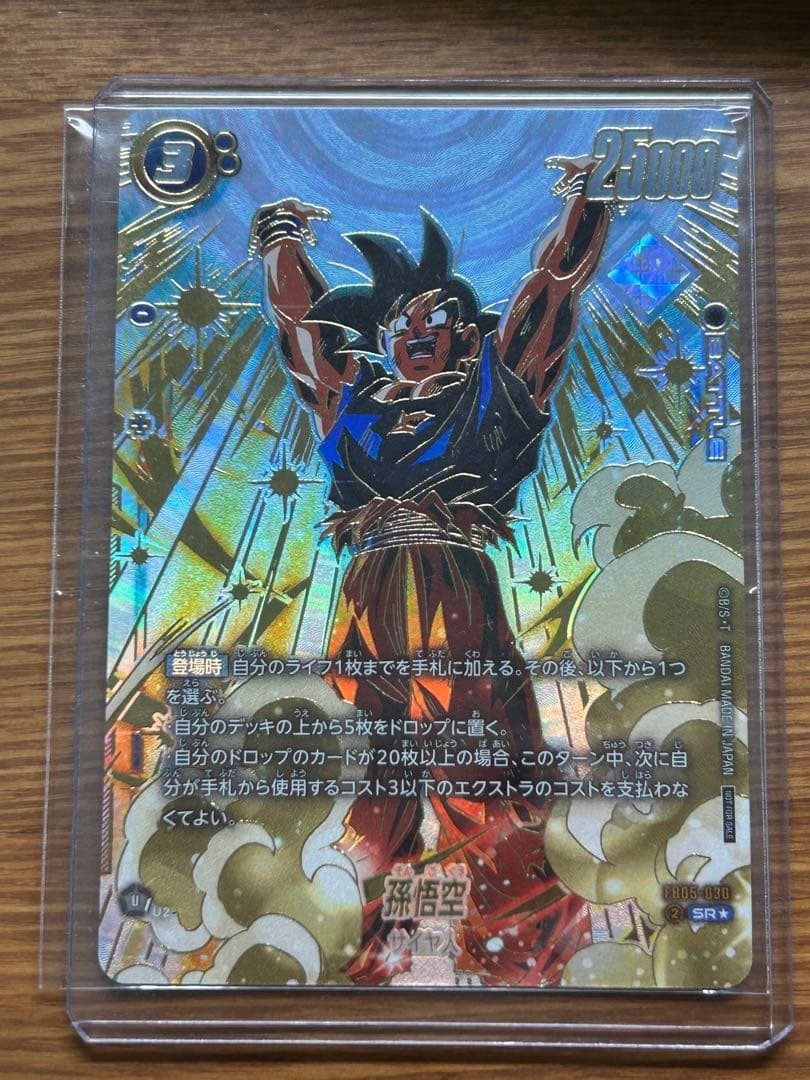
Because Dragon Ball is one of the most collected franchises, it is also one of the most copied. This guide walks through the checks collectors commonly use to evaluate authenticity and condition — the same points our staff in Japan look at when inspecting every item before it ships.
Official Markings and Licensing Indicia

On authentic Dragon Ball trading cards, you can commonly expect to find copyright indicia printed clearly along the card edge or in the lower corner of the back. Cards produced under license typically display attributions such as “© BIRD STUDIO / SHUEISHA” and “© TOEI ANIMATION,” often accompanied by the manufacturer’s mark — Bandai for Carddass and the Super Card Game, or Panini and Fleer for older international runs. The text is usually crisp, uniformly sized, and aligned parallel to the card edge.
Modern Bandai releases (such as Fusion World, Masters, or the older Dragon Ball Super Card Game) also commonly include a small set code, card number, and rarity symbol in a consistent position from card to card within the same set. If copyright lines are missing, blurry, misspelled, or awkwardly placed compared with reference images of the same set, that is a useful signal to investigate further.
Packaging and Print Quality

Sealed Japanese Bandai booster boxes and packs commonly feature tight, factory-crimped foil seams, glossy printing, and Japanese-language product information including a JAN barcode and the Bandai address block. Carddass vending sets often came in small foil packs with a matte finish and simple graphics; reprints and reissues are typically labeled as such (e.g., “Premium Edition” or “Complete Box”), and this is normal — it is not itself a sign of a fake.
On the cards themselves, authentic print work usually shows fine dot patterns under magnification, sharp registration between color layers, and consistent gloss. Foil and prism cards commonly have a distinct refractive pattern (stars, lines, or the classic Carddass rainbow prism) that is difficult to reproduce cleanly. Muddy colors, visible pixelation, off-center art, or a plasticky sheen that differs from known-genuine examples are all worth a closer look.
Stock, Cut, and Material Tells

Genuine Bandai Dragon Ball cards are commonly printed on a firm, slightly flexible cardstock with a smooth coated front and a matte or semi-gloss back. Older Carddass cards tend to be a bit thinner than modern DBSCG or Fusion World cards, but both usually have clean, straight edges with a subtle white core visible when viewed edge-on. The corners are typically cut uniformly, not rough or fuzzy.
When comparing to a suspect card, useful checkpoints include weight in hand, the sound when flexed gently, and the appearance of the edge under light. Bootlegs are often noticeably lighter or heavier, have an unusually bright white or gray core, and may show ink bleeding into the edge. Any card that feels waxy, overly stiff, or unusually flimsy compared with a known-authentic example from the same set deserves further scrutiny.
Japanese Secondhand Condition Grading
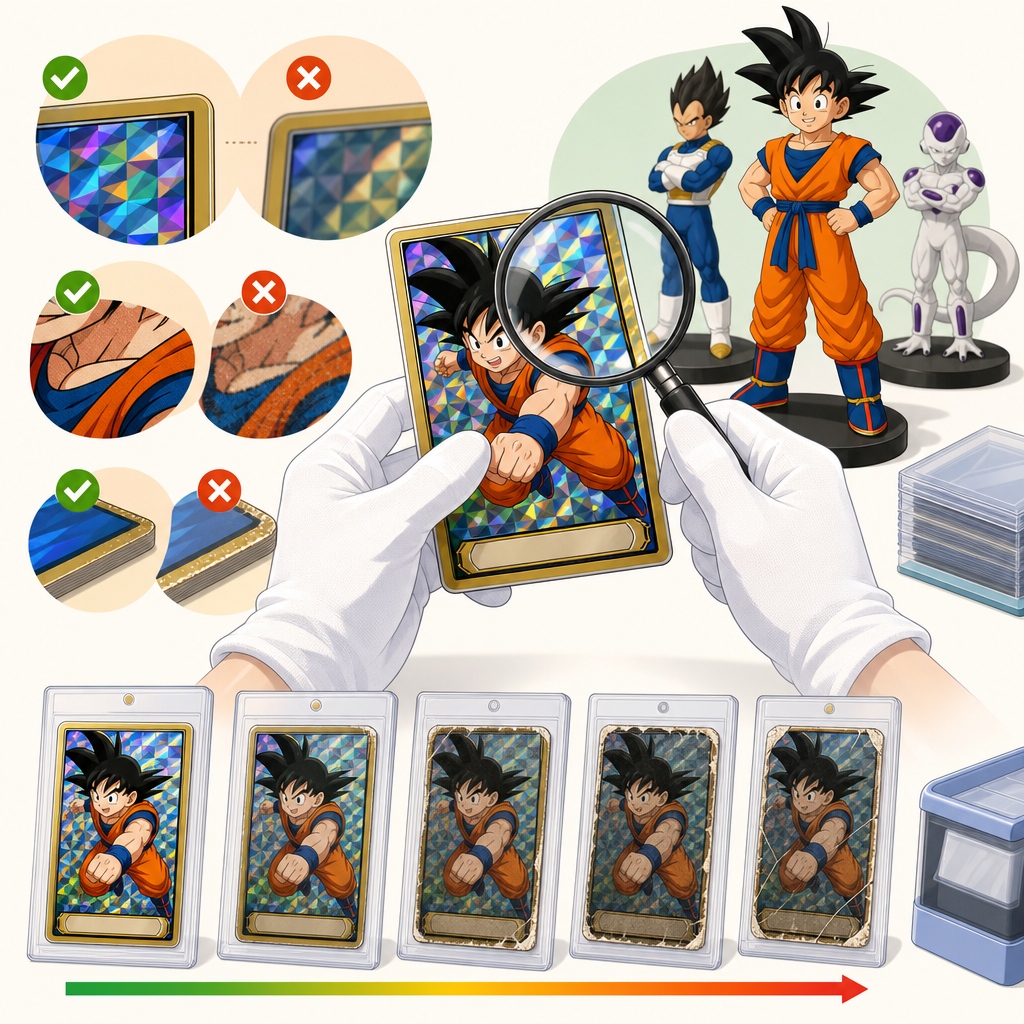
Japanese resellers commonly use a letter-grade shorthand for secondhand cards and sealed products. Unopened (未開封) indicates a still-sealed pack, box, or deck, though the outer shrink may show shelf wear. S or A rank typically means near-mint: sharp corners, clean surface, minimal handling. B rank often covers light play — minor edge wear, small surface scuffs, or slight whitening at corners. C rank usually indicates noticeable wear, creases, or print/centering issues that are still display-acceptable.
Items marked junk (ジャンク) are sold as-is and may have heavy creases, writing, tape residue, water damage, or missing pieces from a set. Grading is subjective and varies by shop, so it is a useful signal rather than a strict standard — always review photos carefully and read the shop’s specific notes about defects.
Buying Safely from Japan
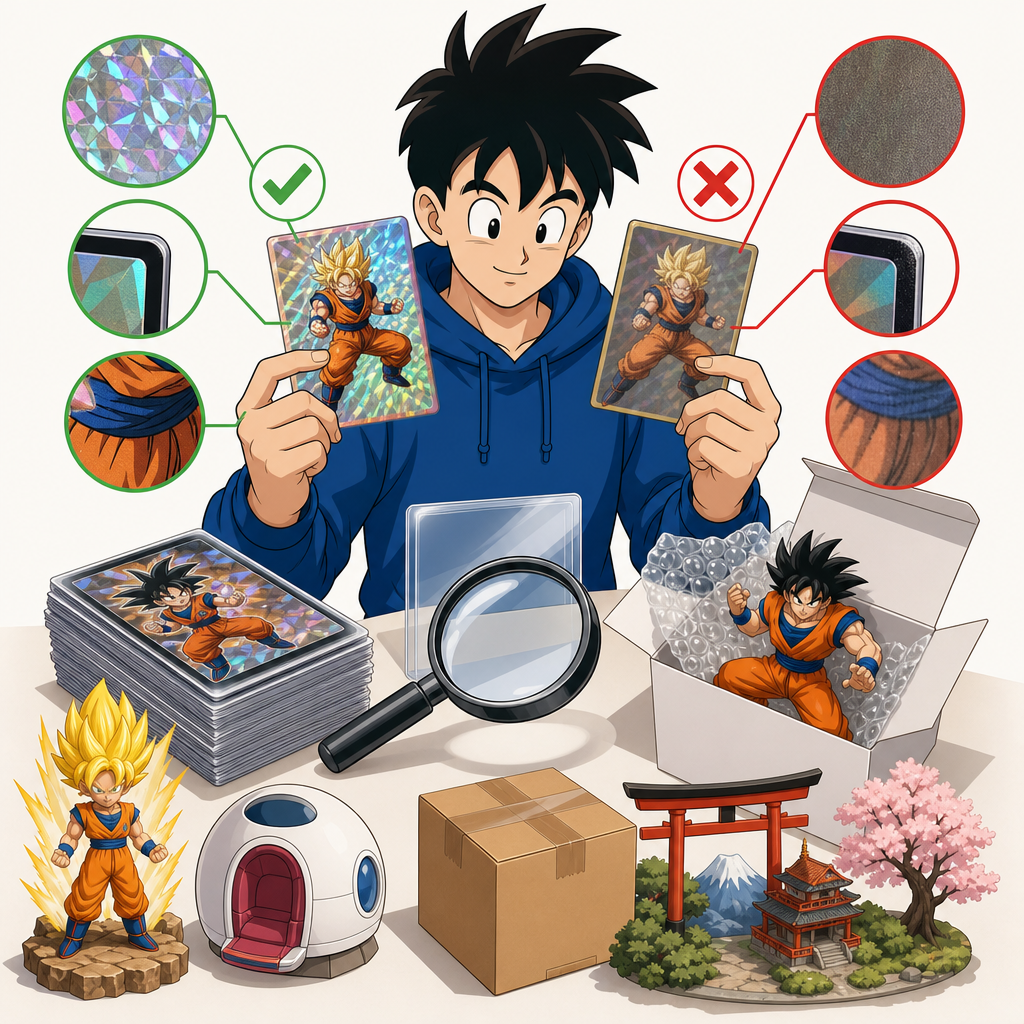
To reduce risk when buying Dragon Ball cards from Japan, it commonly helps to purchase from established secondhand specialists who photograph each lot individually, disclose condition notes, and have a track record with international buyers. Requesting additional photos of the card back, edges, and any foil areas before committing is a reasonable step, and reputable sellers will usually accommodate. For high-value singles, cards graded by third-party services (such as PSA or BGS) provide an added layer of assessment, though grading is an opinion rather than an absolute verdict.
At hdtoysjapan.com we source authentic secondhand Japanese figures and collectibles domestically and describe condition using the grading conventions above. If you are unsure about a Dragon Ball card in your own collection, comparing it side-by-side with a known-genuine example from the same set — and consulting community reference threads — remains one of the most reliable approaches.
Disclaimer: This guide shares general knowledge points that collectors commonly use to evaluate items. It is educational content, not a formal authentication service, and individual items should always be judged on their own evidence. Details can vary by production run and era.
Free Download: Our Full Authenticity Guide (PDF)
Download the free Japanese Figure Authenticity Guide (PDF) →
The complete checklist we use in-house, in a printable format.
Frequently Asked Questions
How can I tell if a Dragon Ball figure is a bootleg?
Check the manufacturer and copyright markings moulded into the base or the back of the figure, compare paint edges and seam lines against official product photos, and look at the print quality of the box. Bootlegs usually fail on several of these at once, not just one.
Is a cheap listing automatically a fake?
No. Price on its own proves nothing — genuine pieces sell cheaply when they are opened, incomplete or from an over-produced run. Judge by markings, finish and packaging rather than by price.
What should I ask a seller for before buying?
Ask for photos of the base markings, the box barcode and any damage in natural light. A seller who handles the item themselves can take these quickly; stock-photo-only listings are the ones worth questioning.
What does Japanese secondhand condition wording mean?
Japanese listings grade strictly: a piece described as used can still be display-quality, while notes about yellowing, paint transfer or box crush are stated explicitly rather than glossed over. Read the condition notes as literal, not as sales copy.
コメント