Because Gundam is one of the most collected franchises, it is also one of the most copied. This guide walks through the checks collectors commonly use to evaluate authenticity and condition — the same points our staff in Japan look at when inspecting every item before it ships.
Official Markings and Licensing Indicators

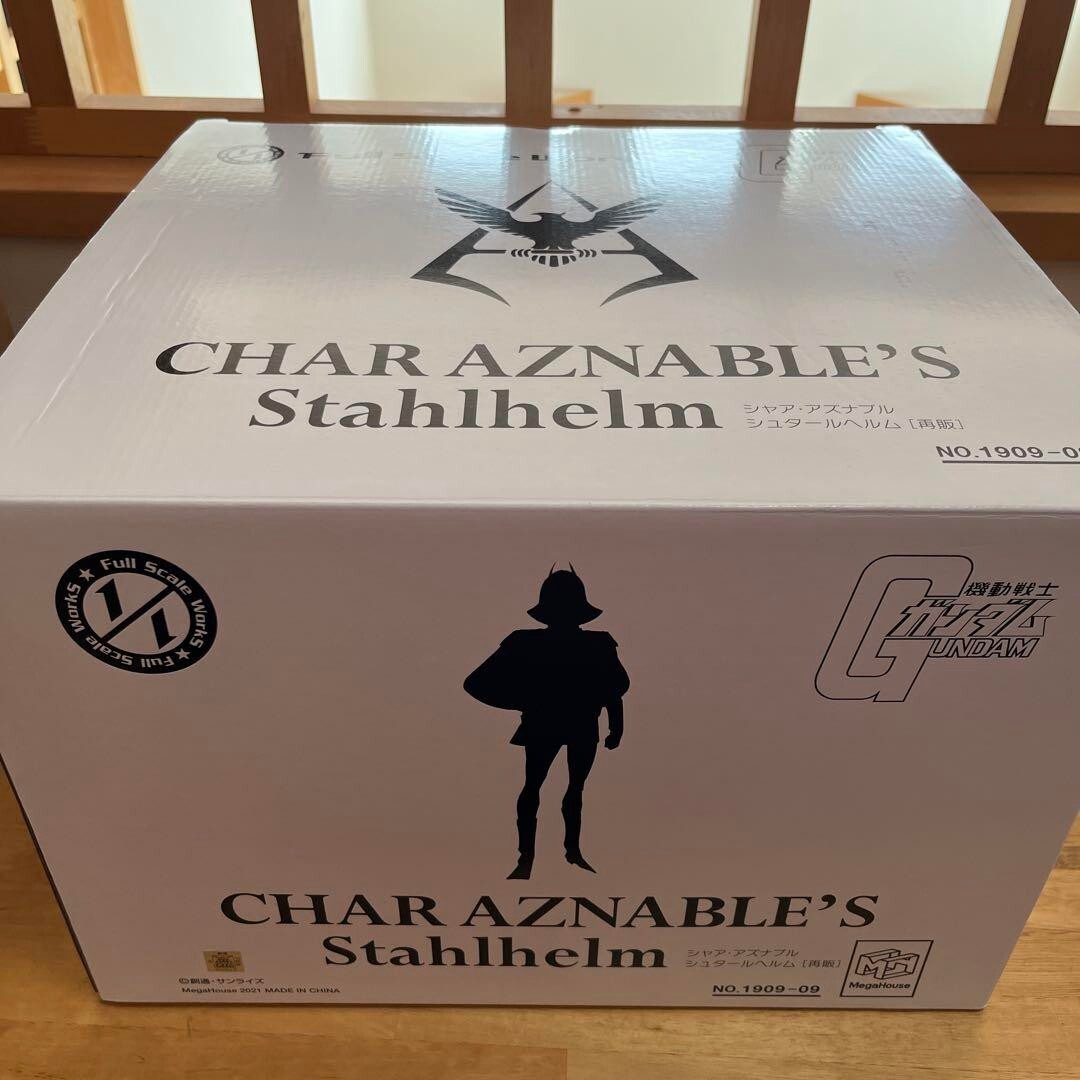
On authentic Gundam scale figures — whether Bandai’s Master Grade, Perfect Grade, HG, or RG plastic model kits, or finished figures under lines like Gundam Fix Figuration (GFF) and MegaHouse’s G.M.G. series — the copyright imprint is a useful first checkpoint. Genuine pieces commonly carry a molded or printed line such as “©創通・サンライズ” (Sotsu · Sunrise) and often the manufacturer name (BANDAI SPIRITS, MegaHouse, etc.). These markings are typically crisp, cleanly aligned, and integrated into the runner tag or figure base rather than appearing as a shallow afterthought.
Boxes for licensed Japanese-market releases commonly show the CERO/age indication where relevant, a JAN barcode starting with 45 or 49 (indicating Japanese registration), and often a small “Made in Japan,” “Made in China,” or “Made in Vietnam” line — all of which are legitimate for Bandai depending on the factory. The presence of these details together tends to be more meaningful than any single mark on its own.
Packaging and Print Quality

Authentic Gundam kit and figure boxes commonly use sturdy, thick cardstock with sharp four-color printing, deep blacks, and cleanly registered Japanese text. Bandai’s iconic red-and-white logo, the Gunpla logo, and series banners (MG, PG, RG, HG, etc.) are usually printed with consistent color across the entire print run — a soft, washed-out red or a slightly blurry logo edge is often a warning sign. Instruction manuals for genuine kits are typically printed on smooth, bright paper with legible Japanese and English callouts and clean line-art diagrams.
Inside the box, official releases commonly include factory-sealed polybags around each runner, a folded manual, and sometimes a marking sticker sheet or waterslide decals. On authentic pieces, runners are usually labeled with a letter (A, B, C…) and the mold/copyright tag molded directly into the sprue frame. Loose, unbagged parts in a shrink-wrapped box, or runners with no molded tag, are commonly reasons for closer inspection.
Paint, Seams, and Material Tells

For finished figures (GFF, Robot Damashii, METAL BUILD, MegaHouse G.M.G., etc.), authentic pieces typically show tight panel lines, cleanly masked two-tone paint on small areas like vents and sensors, and diecast weight in lines that advertise metal parts. Joints on genuine Bandai articulated figures often feel firm but smooth, without gritty resistance or visible mold flash. On plastic model kits, authentic runners are commonly injection-molded in the correct colors from the factory — Bandai’s multi-color runners and clean gate cuts are widely considered a hallmark.
Common tells on questionable items include greasy or oily plastic, strong chemical smell, uneven color between what should be identical parts, soft or rubbery plastic where rigid ABS/PS is expected, and paint that chips or rubs off with light handling. On authentic METAL BUILD or Chogokin-style releases, the diecast sections are usually noticeably heavier and cooler to the touch than surrounding ABS, which can be a helpful comparative signal.
Common Bootleg Red Flags in the Gundam Line
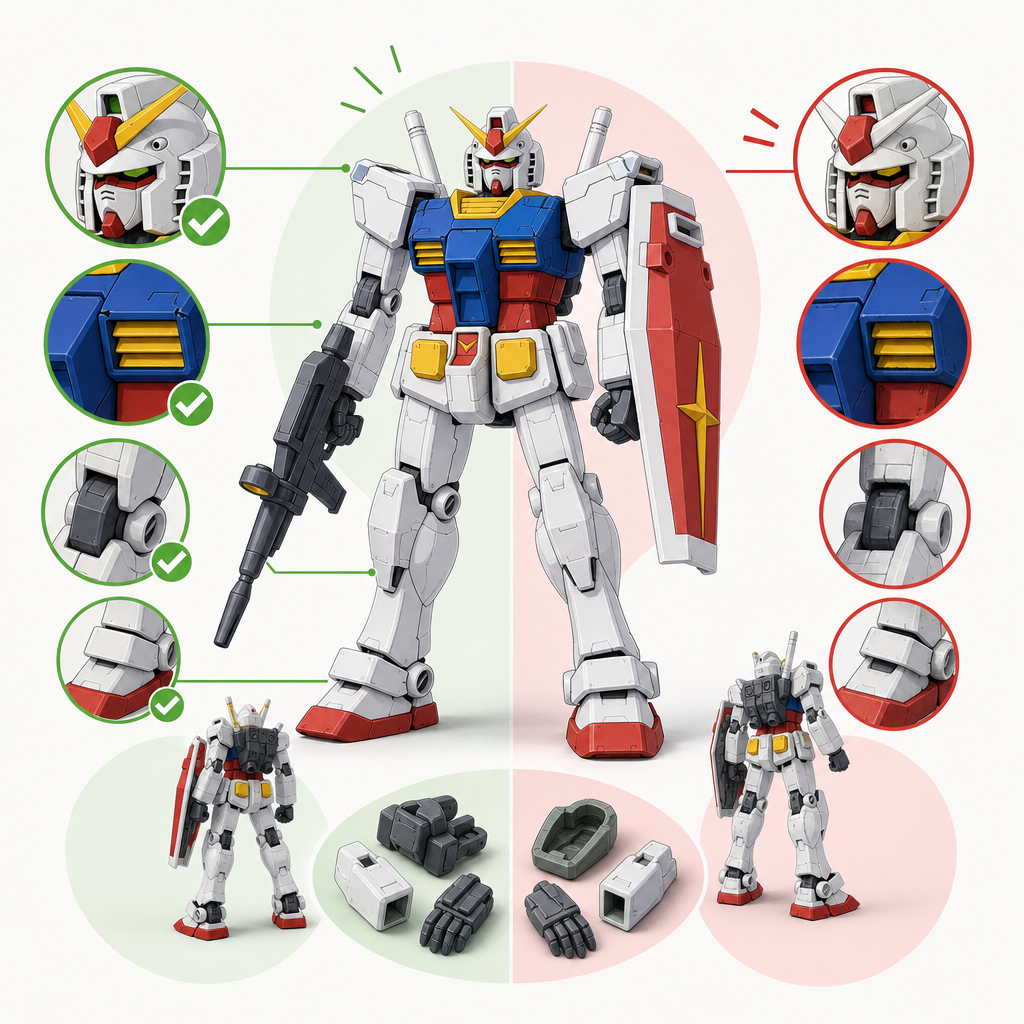
Gunpla and Gundam figures are among the most widely counterfeited Japanese collectibles, so a few patterns come up often. Reproduction MG and PG kits commonly arrive in boxes with slightly off-hue artwork, missing or altered copyright lines, English-only text where Japanese is expected, or a barcode that does not begin with 45/49. Runners in bootleg kits often lack the molded copyright tag, use a single flat color where the original was multi-color, and can have visible flash along part edges.
For finished figures, red flags commonly include mismatched face prints, tampo (pad-printed) markings that are blurry or misaligned, accessories molded in the wrong color, and blister trays that do not fit the parts snugly. Prices dramatically below the typical Japanese secondhand market — especially for sought-after items like METAL BUILD or PG Unleashed releases — are also frequently a reason for extra caution rather than a bargain to trust at face value.
Japanese Secondhand Condition Grading
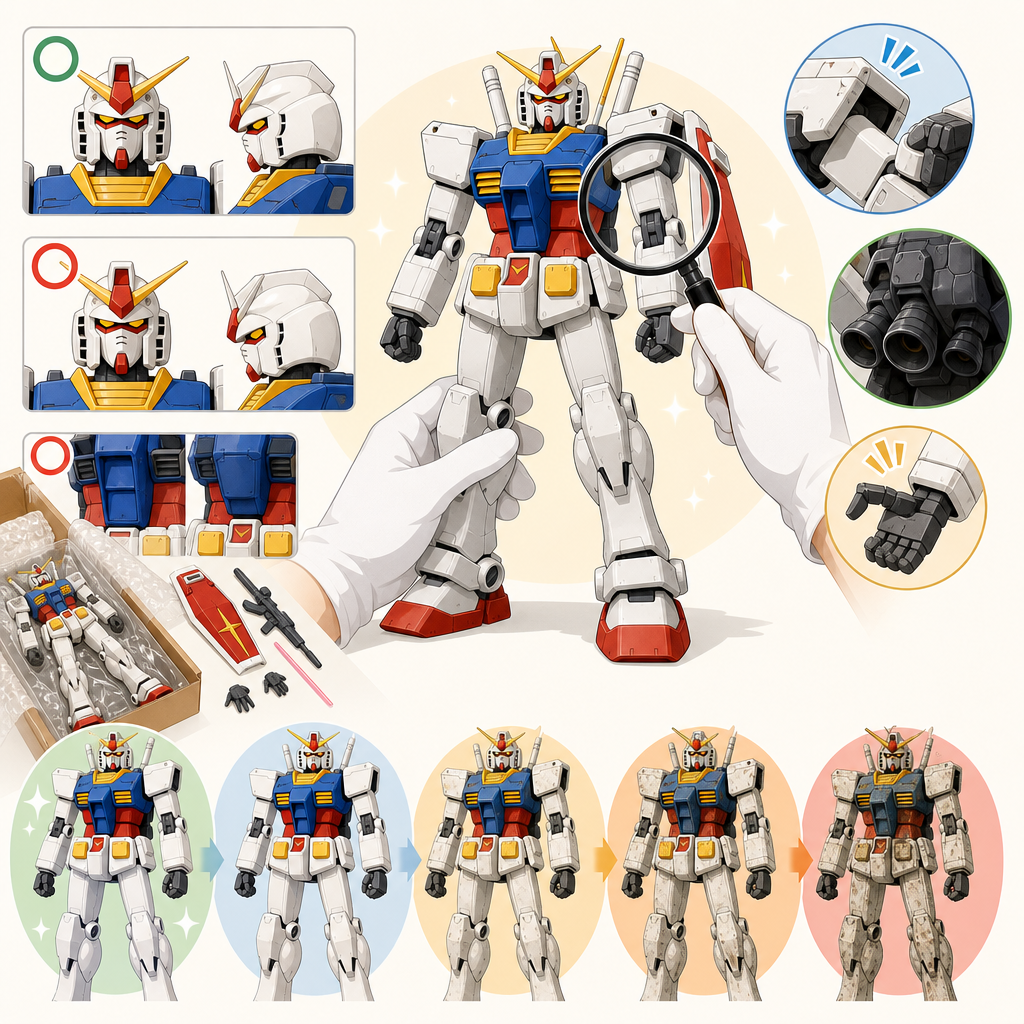
Japanese resellers commonly use a shorthand grading system that is worth understanding before buying. “未開封” (mikaifū / unopened) generally means the box is factory-sealed or at least never opened, though shelf wear on the outer box is still possible. Grade A typically indicates an opened item in excellent condition with all parts, manual, and accessories present and minimal signs of display. Grade B commonly means visible play or display wear — light paint rub, minor yellowing, or a creased box — but the item is complete and displayable.
Grade C usually signals significant wear, missing minor accessories, loose joints, or notable box damage, while “ジャンク” (junk) is commonly used for incomplete, broken, or heavily damaged pieces sold as-is for parts or restoration. These grades are subjective and vary by shop, so photos and written notes about missing decals, yellowing (common on older white Gunpla), and joint tightness are often more informative than the letter grade alone.
Buying Safely from Japan

When sourcing Gundam figures and kits from Japan, buying from established secondhand specialists — rather than anonymous marketplace listings — is generally the safer path. Reputable Japan-based sellers commonly provide multiple clear photos of the actual item (not stock images), close-ups of runners or figure markings, notes on completeness of decals and instructions, and honest disclosure of yellowing, stickering, or box damage. Asking for extra photos of the copyright tag or barcode before purchase is a reasonable request that legitimate shops are usually happy to accommodate.
It also helps to cross-reference the release against Bandai’s or MegaHouse’s official product archives to confirm box art, included accessories, and country of manufacture for that specific run. No inspection process can offer absolute certainty, but combining trusted sourcing, careful photo review, and familiarity with the traits described above tends to significantly reduce the risk of ending up with a bootleg or misgraded piece.
Disclaimer: This guide shares general knowledge points that collectors commonly use to evaluate items. It is educational content, not a formal authentication service, and individual items should always be judged on their own evidence. Details can vary by production run and era.
Free Download: Our Full Authenticity Guide (PDF)
Download the free Japanese Figure Authenticity Guide (PDF) →
The complete checklist we use in-house, in a printable format.
Frequently Asked Questions
How can I tell if a Gundam figure is a bootleg?
Check the manufacturer and copyright markings moulded into the base or the back of the figure, compare paint edges and seam lines against official product photos, and look at the print quality of the box. Bootlegs usually fail on several of these at once, not just one.
Is a cheap listing automatically a fake?
No. Price on its own proves nothing — genuine pieces sell cheaply when they are opened, incomplete or from an over-produced run. Judge by markings, finish and packaging rather than by price.
What should I ask a seller for before buying?
Ask for photos of the base markings, the box barcode and any damage in natural light. A seller who handles the item themselves can take these quickly; stock-photo-only listings are the ones worth questioning.
What does Japanese secondhand condition wording mean?
Japanese listings grade strictly: a piece described as used can still be display-quality, while notes about yellowing, paint transfer or box crush are stated explicitly rather than glossed over. Read the condition notes as literal, not as sales copy.
コメント