Because Pokemon is one of the most collected franchises, it is also one of the most copied. This guide walks through the checks collectors commonly use to evaluate authenticity and condition — the same points our staff in Japan look at when inspecting every item before it ships.
Official Markings and Licensing Tags

On authentic Pokémon plush, the sewn-in hang tag is often one of the most useful signals of legitimacy. Genuine pieces produced for the Japanese market commonly carry a Pokémon Center or Takara Tomy Arts tag printed in crisp color, and typically include copyright text along the lines of “© Pokémon / Nintendo / Creatures / GAME FREAK” together with the licensee’s name. The character name is usually printed in both English and Japanese, and the tag paper tends to feel sturdy rather than flimsy.
A second cloth care label is commonly sewn into a seam, generally showing Japanese-language wash instructions, material composition (often polyester fiber), and a country of manufacture such as China or Vietnam. On authentic pieces the printing is usually sharp and evenly aligned, and Pokémon Center exclusives frequently include a small holographic or foil-stamped element on the paper tag — a detail that bootlegs often approximate poorly.
Packaging and Print Quality

Many Pokémon plush are sold loose with only a hang tag, but boxed or bagged variants (such as promotional or arcade prize plush) commonly show high-quality offset printing with clean, saturated colors and legible small text. On authentic packaging, licensing credits, barcodes, and the Pokémon logo are usually reproduced sharply, and Japanese prize-machine (“Ichiban Kuji,” “amuse prize”) plush often carry a printed “Not for sale” (非売品) notice or prize-category label.
Print alignment is a useful checkpoint: on genuine items, the character eyes, mouth embroidery, and any printed detail tend to be symmetrical and centered, and colors generally match official reference images from the Pokémon Center site or the manufacturer’s product page. Washed-out tones, pixelated logos, or misspellings in either English or Japanese are commonly considered warning signs.
Stitching, Material, and Paint Tells

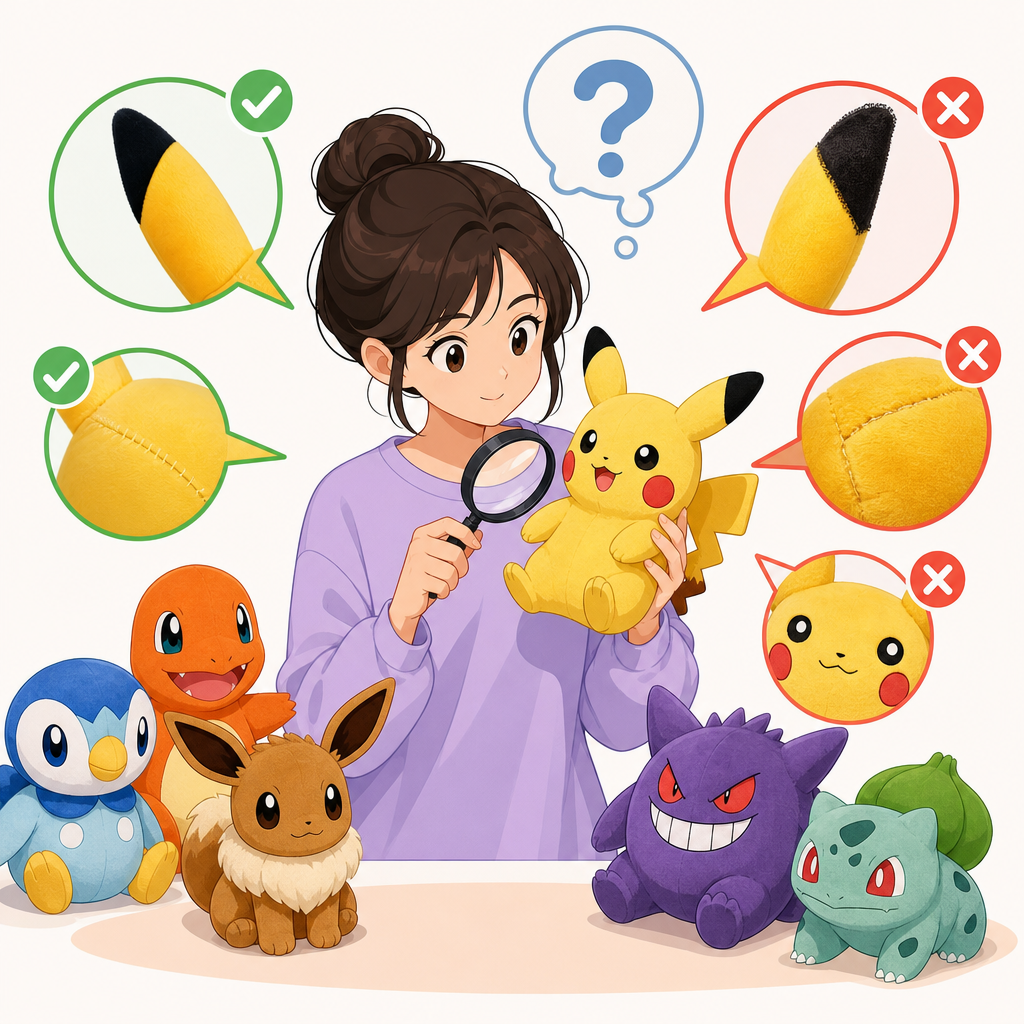
Authentic Pokémon plush commonly use soft, short-pile polyester or minky-style fabric with consistent color across panels. Seams are typically tight and even, with stuffing distributed so the pose matches official promotional photos — Pikachu’s cheeks, Eevee’s ruff, or Snorlax’s belly, for example, generally hold a recognizable silhouette rather than looking lumpy or deflated. Embroidered eyes and mouths on genuine pieces are usually dense and cleanly outlined, without loose threads crossing the face.
For plush that include plastic or painted parts (eyes, beaks, accessories), authentic examples often show smooth, evenly applied paint without heavy overspray onto surrounding fabric. Colors should generally match the Pokémon’s official artwork; noticeably off shades — a mustard-yellow Pikachu, a pink-tinted Eevee, or mismatched eye colors — are frequently cited as red flags in the collector community.
Common Bootleg Red Flags in the Pokémon Line

Because Pokémon is one of the most counterfeited franchises, several recurring tells are worth checking. Bootleg plush commonly have generic paper tags with no licensee name, only a vague “Pokémon” logo, or tags written entirely in English when the piece is claimed to be a Japanese Pokémon Center release. Missing cloth care labels, or care labels with garbled Japanese, are also often reported.
Proportions are another useful check: unauthorized copies frequently exaggerate head size, place eyes too close together, or use the wrong tail shape. Suspiciously low prices for sought-after Pokémon Center exclusives, sellers unable to provide clear photos of both tags, and “new with tags” listings where the tag design does not match known references for that release year are all commonly treated as reasons to investigate further before buying.
Japanese Secondhand Condition Grading

Japanese resellers commonly use a tiered grading system that is helpful to understand when shopping plush. “Unopened” or “new with tags” (新品・タグ付き) generally means the hang tag is still attached and the plush shows no signs of display or handling. “A” rank typically describes a used item in excellent condition with tags possibly removed but minimal wear. “B” rank often indicates visible but minor issues such as light fading, slight fabric flattening, or a missing hang tag.
“C” rank commonly denotes noticeable wear — stains, pilling, loose stitching, or stronger fading — while “junk” (ジャンク) is generally reserved for items with significant damage, odor, or missing parts, sold as-is for parts or restoration. These grades are subjective and vary by shop, so reading each listing’s specific notes and photos is usually more reliable than trusting the letter alone.
Buying Safely from Japan

When sourcing Pokémon plush from Japan, buying from established secondhand specialists or dedicated figure and plush shops generally reduces risk, since reputable sellers typically inspect items, note tag status, and photograph both the front and the sewn-in labels. Requesting additional photos of the hang tag, care label, and any areas of wear before purchase is a common and accepted practice.
It also helps to cross-reference the specific release — Pokémon Center “fit,” “I Choose You,” Pokémon Time, or Ichiban Kuji lines each have recognizable tag designs and release years documented on collector wikis and archived Pokémon Center pages. While no single check can confirm authenticity with certainty, combining tag inspection, proportion checks, seller reputation, and price sanity offers a reasonably strong overall signal for most Pokémon plush purchases.
Disclaimer: This guide shares general knowledge points that collectors commonly use to evaluate items. It is educational content, not a formal authentication service, and individual items should always be judged on their own evidence. Details can vary by production run and era.
Free Download: Our Full Authenticity Guide (PDF)
Download the free Japanese Figure Authenticity Guide (PDF) →
The complete checklist we use in-house, in a printable format.
Frequently Asked Questions
How can I tell if a Pokemon figure is a bootleg?
Check the manufacturer and copyright markings moulded into the base or the back of the figure, compare paint edges and seam lines against official product photos, and look at the print quality of the box. Bootlegs usually fail on several of these at once, not just one.
Is a cheap listing automatically a fake?
No. Price on its own proves nothing — genuine pieces sell cheaply when they are opened, incomplete or from an over-produced run. Judge by markings, finish and packaging rather than by price.
What should I ask a seller for before buying?
Ask for photos of the base markings, the box barcode and any damage in natural light. A seller who handles the item themselves can take these quickly; stock-photo-only listings are the ones worth questioning.
What does Japanese secondhand condition wording mean?
Japanese listings grade strictly: a piece described as used can still be display-quality, while notes about yellowing, paint transfer or box crush are stated explicitly rather than glossed over. Read the condition notes as literal, not as sales copy.

コメント