Because Saint Seiya is one of the most collected franchises, it is also one of the most copied. This guide walks through the checks collectors commonly use to evaluate authenticity and condition — the same points our staff in Japan look at when inspecting every item before it ships.
Official Markings and Licensing Indicators

On authentic Saint Seiya scale figures, collectors commonly look for clear licensing text molded or printed near the base, such as references to Masami Kurumada, Toei Animation, and the manufacturer (for example Bandai Spirits for Myth Cloth EX and Saint Cloth Myth lines, or names like Bandai, Medicos, or CCP for other releases). These credits are usually crisp, evenly spaced, and legible without smearing.
Boxes on genuine pieces often carry printed or stickered indicators such as a Japanese barcode (typically starting with 45 or 49), a small copyright block on the back panel, and, for domestic releases, some Japanese-language safety or age text. A missing or blurry copyright line is a useful signal to investigate further, though minor variations across production runs do occur.
Packaging and Print Quality

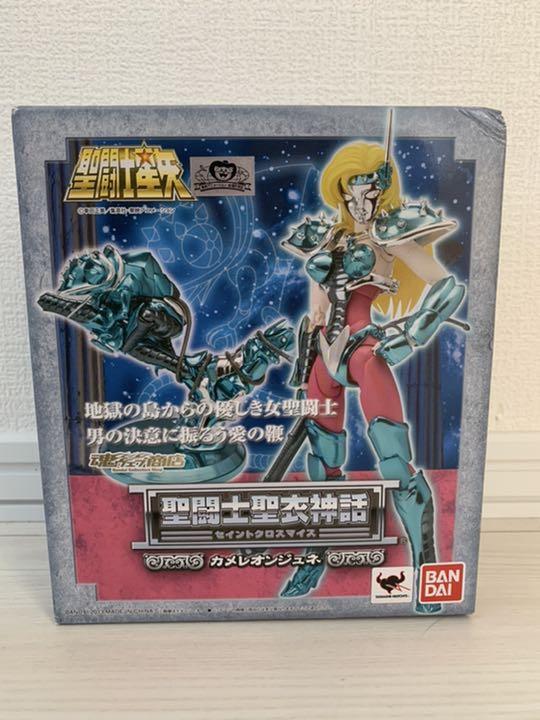
Authentic Saint Seiya figure boxes are commonly printed on sturdy, coated cardstock with sharp color separation, deep blacks, and smooth gradients on the character artwork. The window plastic (blister) is typically clear, well-trimmed, and fitted snugly to the tray, and inserts holding armor parts are often molded to match each accessory precisely.
Red flags in packaging include off-register printing, dot patterns visible to the naked eye, washed-out gold or metallic inks on the logo, and generic or poorly cut inner trays. On real releases, the Saint Seiya logo and series sub-logo (such as Myth Cloth EX or Saint Cloth Legend) are usually reproduced consistently with the artwork used on official promotional material.
Paint, Seams, and Material Tells

Genuine Saint Seiya scale and Cloth figures commonly use a mix of ABS, PVC, and — especially on Myth Cloth lines — significant die-cast metal parts in the armor. Authentic pieces often have a noticeable weight, cleanly plated chrome or pearl finishes, and paint applications that stay within sculpted panel lines. Joints usually move with firm, consistent resistance rather than feeling loose or gritty.
On the sculpt, hair strands, facial features, and armor engravings tend to be sharp and symmetrical, with tampo-printed details (eyes, small emblems) aligned correctly. Bootlegs frequently show softer detail, chalky or overly glossy paint, brittle plastic in place of metal, visible mold seams across the face, and mismatched color tones between armor pieces.
Common Bootleg Red Flags in the Saint Seiya Line

Because Saint Cloth Myth and Myth Cloth EX have been reissued many times, unofficial copies do circulate. Warning signs commonly reported by collectors include: armor parts that will not clip on securely, cloth object mode assemblies that cannot form the correct totem, generic plain-white inner boxes with no printed character name, and instruction sheets printed on thin paper with blurry diagrams.
Pricing that is dramatically below typical Japanese secondhand market levels for sought-after Gold Saints or Divine Cloth releases is also a useful signal for caution. Genuine reissues are usually documented on manufacturer sites and in hobby magazines, so cross-checking the exact subtitle (for example “Revival Edition” or “~Original Color Edition~”) against known official releases can help confirm a piece.
Japanese Secondhand Condition Grading

Japanese resellers commonly use a tiered system that Saint Seiya buyers will see often. Unopened / Shinpin means factory-sealed, though outer shrink may still show shelf wear. A rank typically indicates an opened item in excellent condition with all parts, stickers unapplied or neatly applied, and a clean box. B rank often means visible play wear, minor paint rubs on armor edges, or yellowing on white plastics. C rank usually points to significant wear, loose joints, or noticeable discoloration.
Items marked junk (ジャンク) commonly have missing parts, broken tabs, heavy oxidation on die-cast, or non-functional joints, and are generally sold for parts or restoration. For Saint Seiya specifically, watch for notes about the condition of small accessories such as face parts, effect pieces, name plates, and object mode stands, since these are frequently lost.
Disclaimer: This guide shares general knowledge points that collectors commonly use to evaluate items. It is educational content, not a formal authentication service, and individual items should always be judged on their own evidence. Details can vary by production run and era.
Free Download: Our Full Authenticity Guide (PDF)
Download the free Japanese Figure Authenticity Guide (PDF) →
The complete checklist we use in-house, in a printable format.
Frequently Asked Questions
How can I tell if a Saint Seiya figure is a bootleg?
Check the manufacturer and copyright markings moulded into the base or the back of the figure, compare paint edges and seam lines against official product photos, and look at the print quality of the box. Bootlegs usually fail on several of these at once, not just one.
Is a cheap listing automatically a fake?
No. Price on its own proves nothing — genuine pieces sell cheaply when they are opened, incomplete or from an over-produced run. Judge by markings, finish and packaging rather than by price.
What should I ask a seller for before buying?
Ask for photos of the base markings, the box barcode and any damage in natural light. A seller who handles the item themselves can take these quickly; stock-photo-only listings are the ones worth questioning.
What does Japanese secondhand condition wording mean?
Japanese listings grade strictly: a piece described as used can still be display-quality, while notes about yellowing, paint transfer or box crush are stated explicitly rather than glossed over. Read the condition notes as literal, not as sales copy.

コメント